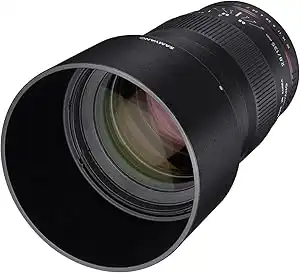
The Canon EF 135mm f/2L USM stands as a revered optic within the Canon EF lens lineup, a testament to its enduring performance and optical excellence. As an L-series telephoto prime, it carries Canon's professional-grade designation, signifying robust build quality and superior image rendition. Renowned for its exceptional sharpness, incredibly fast f/2 aperture, and the exquisite quality of its out-of-focus areas, it has carved out a niche as a go-to lens for professionals seeking to isolate subjects with a shallow depth of field. This review will delve into its specifications, performance, and the specific photographic scenarios where it truly shines, providing a balanced perspective on its capabilities and limitations.
Optically, the EF 135mm f/2L USM is a prime lens, meaning it features a fixed focal length of 135mm. This telephoto perspective, particularly on a full-frame sensor, offers a natural and flattering compression, making it ideal for portraiture while also providing sufficient reach for events or isolating elements in a scene. The lens comprises 10 elements arranged in 8 groups, a relatively complex design for a prime lens, contributing to its high optical performance. Its maximum aperture of f/2 is remarkably fast, allowing for significant light gathering in challenging conditions and facilitating the creation of extremely shallow depth of field. The minimum aperture is f/22, offering extensive control over exposure and depth of field when desired. An 8-blade circular aperture diaphragm ensures that specular highlights and out-of-focus elements maintain a pleasingly rounded appearance, even when stopped down slightly from wide open.
In terms of physical attributes, the lens is built to L-series standards, implying a durable and weather-resistant construction suitable for professional use. It weighs a substantial 750 grams, a comfortable weight for its class and focal length, providing a sense of solidity without being overly cumbersome for extended shooting sessions. The front element accepts 72mm screw-in filters. A notable omission for a lens of this focal length and era is the lack of image stabilization. While not a deal-breaker for all applications, its absence necessitates higher shutter speeds or a tripod in low light to mitigate camera shake, especially when hand-holding, particularly relevant on DSLR bodies which do not offer in-body image stabilization. The minimum focus distance of 0.9 meters (approximately 3 feet) allows for a maximum magnification of 0.19x, which, while not truly macro, provides ample flexibility for tighter headshots or detail shots.
The core of the EF 135mm f/2L USM's reputation lies in its optical performance. Sharpness is a particular highlight; the lens delivers outstanding acuity from corner to corner, even wide open at f/2. This wide-open sharpness is crucial for photographers who rely on fast apertures for subject isolation. As expected from an L-series prime, chromatic aberrations are generally well-controlled, though some minor longitudinal chromatic aberration (bokeh fringing) can occasionally be observed in high-contrast transitions at wider apertures, a characteristic shared by many fast primes. Vignetting is present at f/2 but quickly diminishes as the lens is stopped down, and for many photographers, this subtle light fall-off can even enhance the perception of subject isolation.
However, it is the lens's bokeh quality that truly distinguishes it. The combination of the 135mm focal length on a full-frame sensor and the fast f/2 aperture produces exceptionally smooth, creamy, and aesthetically pleasing background blur. This "excellent bokeh" is instrumental in separating subjects from busy or distracting backgrounds, rendering them with a three-dimensional pop that is highly sought after in various photographic disciplines. The 8-blade circular aperture contributes significantly to the pleasing rendition of out-of-focus lights, producing soft, round highlights rather than polygonal shapes.
Autofocus performance is another strong suit, thanks to the inclusion of Canon's USM (Ultrasonic Motor) technology. The USM system delivers fast, accurate, and remarkably quiet autofocus, which is crucial for capturing fleeting moments in events or candid street scenes without drawing undue attention. The internal focusing mechanism means the front element does not rotate during focusing, making the use of polarizing or graduated neutral density filters straightforward.
The EF 135mm f/2L USM excels in several specific use cases:
- Portrait Photography: This is arguably the lens's strongest domain. The 135mm focal length provides a flattering perspective, creating natural-looking facial features and body proportions without distortion. The f/2 aperture allows for incredible subject isolation and beautiful bokeh, making subjects truly stand out.
- Wedding and Event Photography: Its fast f/2 aperture is invaluable in the often challenging, low-light environments of weddings and events. It allows photographers to capture moments with available light, keeping ISO settings lower and shutter speeds fast enough to freeze action, while simultaneously isolating key subjects from the often chaotic backgrounds.
- Low-Light Photography: The ability to open up to f/2 makes this lens a powerful tool for shooting in dim conditions. It allows for faster shutter speeds, reducing motion blur, or lower ISOs, minimizing noise, without the need for flash.
- Street Photography (for isolation): While not a traditional street photography focal length, the 135mm can be used effectively for isolating individuals or specific scenes from a distance, providing a discreet way to capture candid moments with strong subject separation.
In conclusion, the Canon EF 135mm f/2L USM is a legendary prime lens that continues to hold its own against newer designs, even in the mirrorless era via adapters. Its combination of outstanding sharpness, remarkably fast f/2 aperture, and exquisite bokeh makes it an indispensable tool for photographers prioritizing subject isolation and beautiful background rendering. While the absence of image stabilization requires careful handling in some situations, and its prime nature demands a "zoom with your feet" approach, these minor considerations are often overshadowed by its unparalleled optical performance. For portrait, wedding, event, and low-light photographers who value image quality and the distinctive look of a fast telephoto prime, the EF 135mm f/2L USM remains an exceptional and highly recommended lens.