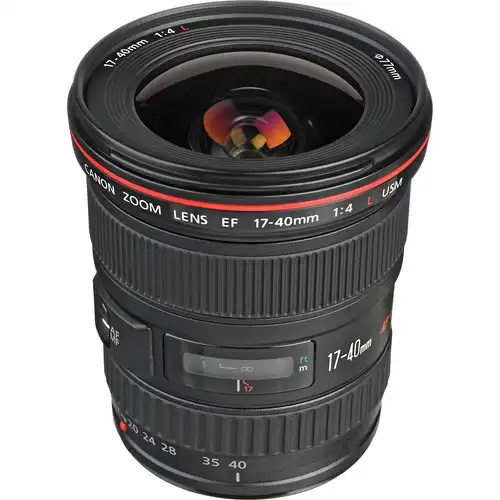
The Canon EF 17-40mm f/4L USM lens stands as a testament to Canon's enduring commitment to the EF mount, offering a versatile wide-angle zoom solution for full-frame DSLR users. Positioned within Canon's prestigious L-series, it promises professional-grade build quality and optical performance, albeit at a more accessible constant aperture of f/4 compared to its f/2.8 brethren. Since its introduction, it has carved out a niche as a popular choice for photographers seeking a lightweight, robust, and capable wide-angle lens for a variety of demanding applications.
From a construction standpoint, the 17-40mm f/4L embodies the ruggedness expected of an L-series optic. Its robust build, featuring dust and moisture-resistant construction, instills confidence when shooting in challenging environments, making it a reliable companion for outdoor adventures and unpredictable weather. Despite its professional lineage, it remains relatively lightweight at 475g, contributing to a more balanced and manageable setup when paired with most DSLR bodies, particularly beneficial for travel and extended handheld shooting. The lens incorporates a 77mm filter thread, a common size that allows for easy integration with a photographer's existing filter collection, a practical consideration for landscape and architectural work where filters are often indispensable. The seven-blade circular diaphragm, while not the highest count, aims to produce pleasing out-of-focus areas when depth of field is shallow enough, though this is less frequently the primary concern with a wide-angle f/4 lens.
Optically, the EF 17-40mm f/4L USM is designed to deliver sharp images across its versatile zoom range. The internal structure comprises 12 elements in 9 groups, featuring three Aspherical elements and one Super UD (Ultra-low Dispersion) element. These specialized elements are crucial for correcting various optical aberrations, including spherical aberrations and chromatic aberrations, which are particularly challenging to manage in wide-angle zoom designs. The Super UD element works to minimize color fringing, contributing to cleaner, more accurate colors and improved detail rendition.
In terms of sharpness, the lens generally performs well, particularly in the center of the frame at moderate apertures (f/8-f/11), which aligns perfectly with its suitability for landscape and architecture where edge-to-edge sharpness is often desired. Wide open at f/4, central sharpness is good, though some softening can be observed in the corners, a characteristic not uncommon for wide-angle zooms. Stopping down typically improves corner performance significantly. Vignetting is present at wider apertures and focal lengths, as expected from a full-frame wide-angle lens, but it is generally manageable and easily corrected in post-processing. Distortion, particularly barrel distortion at 17mm, is also noticeable but well within the range of software correction tools. Chromatic aberrations are generally well controlled thanks to the Super UD element, appearing as minor fringing in high-contrast areas. Flare control is respectable, a benefit of Canon's L-series coatings, though direct strong light sources can still induce some ghosting or veiling flare, necessitating careful composition.
The autofocus system is powered by Canon's ring-type USM (Ultrasonic Motor), renowned for its speed, accuracy, and near-silent operation. This is a significant advantage for both stills and video work, ensuring quick and decisive focusing even in challenging lighting conditions. The USM also allows for full-time manual focus override, enabling photographers to fine-tune focus without switching out of AF mode. With a minimum focusing distance of 0.28 meters and a maximum magnification of 0.24x, the lens offers reasonable close-up capabilities for a wide-angle, allowing for some creative foreground emphasis.
A notable absence in the feature set is optical image stabilization (IS). While less critical for extremely wide-angle photography than for telephoto lenses, its inclusion would have broadened its versatility, particularly for handheld shooting in low-light conditions or for video work where camera shake can be more pronounced. Users will need to rely on higher ISO settings, faster shutter speeds, or tripod use to compensate, especially in dimmer environments.
The Canon EF 17-40mm f/4L USM excels in several specific use cases:
- Landscape Photography: The wide 17mm end is ideal for capturing expansive vistas, sweeping horizons, and dramatic foregrounds. Its weather-sealed construction makes it a dependable choice for outdoor environments, from misty mornings to dusty trails. The sharp performance at typical landscape apertures (f/8-f/16) ensures detail across the frame.
- Architecture Photography: Its ability to capture broad perspectives makes it excellent for photographing buildings, interiors, and cityscapes. The relatively low distortion for a wide-angle zoom, coupled with its sharpness, helps in rendering straight lines accurately, which is paramount in architectural work.
- Travel Photography: The lightweight design and versatile focal range from ultra-wide to a standard wide-angle make it an excellent choice for travel. It's capable of capturing grand scenery, cramped street scenes, and impressive interiors without adding excessive bulk to a travel kit.
- General Wide-Angle Photography: Beyond these specific genres, the 17-40mm is a strong performer for any situation demanding a broad field of view, such as group portraits, large event coverage, or real estate photography.
In conclusion, the Canon EF 17-40mm f/4L USM remains a highly competent and relevant lens for Canon EF-mount DSLR users, particularly those on full-frame bodies. Its L-series build quality, reliable USM autofocus, and generally strong optical performance – especially at its price point – make it an attractive option. While it lacks image stabilization and its corner sharpness at f/4 isn't class-leading, these are often acceptable trade-offs for its robust construction, relatively light weight, and consistent performance across its wide-angle zoom range. For photographers prioritizing a durable, versatile, and professional-grade wide-angle zoom for landscapes, architecture, and travel, the EF 17-40mm f/4L USM continues to deliver significant value.