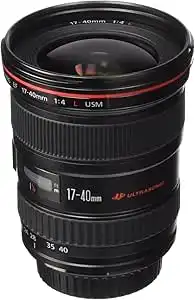
The Canon TS-E 17mm f/4L stands as a specialized, high-performance L-series prime lens, uniquely positioned within Canon’s EF mount ecosystem. Designed specifically for full-frame DSLR cameras, this ultra-wide-angle optic is renowned for its tilt-shift capabilities, offering photographers an unparalleled degree of perspective and plane of focus control. Its designation as an L-series lens immediately signals a commitment to professional-grade build quality, advanced optical design, and robust performance, attributes that are critical given its niche application.
At its core, the 17mm fixed focal length provides an expansive field of view, making it an ideal candidate for capturing grand vistas, sprawling interiors, and imposing architectural structures. However, what truly sets this lens apart is its sophisticated tilt-shift mechanism. Unlike conventional lenses, the TS-E 17mm f/4L allows for independent movement of the optical axis relative to the sensor plane. The "shift" function enables the lens to move parallel to the sensor, effectively correcting converging vertical lines in architectural photography—a phenomenon often referred to as keystone distortion—without tilting the camera. This is invaluable for maintaining natural-looking, undistorted lines when photographing tall buildings or interiors, ensuring subjects appear true to life. The "tilt" function, conversely, allows the lens to pivot on an axis, altering the plane of focus. This capability, based on the Scheimpflug principle, can dramatically extend or selectively narrow the depth of field, enabling photographers to keep an entire scene sharp from foreground to background, or conversely, to create a miniature effect by rendering only a narrow band of the image in sharp focus.
Optically, the TS-E 17mm f/4L lives up to its L-series heritage. Comprising 12 elements in 10 groups, its complex optical formula is engineered to deliver exceptional sharpness and clarity across the entire image frame, even at wider apertures. A critical aspect of its design is its rectilinear correction, which means that straight lines remain straight, even at the extreme edges of the ultra-wide field of view. This is a paramount consideration for architectural and interior photography, where any barrel or pincushion distortion would be immediately noticeable and detract from the realism of the scene. Chromatic aberrations and flare are also meticulously controlled, contributing to images with high contrast and accurate color rendition. The fixed f/4 maximum aperture provides a respectable amount of light-gathering capability for its wide-angle nature, and the 8-blade circular diaphragm helps in rendering pleasing out-of-focus areas, though bokeh is less of a primary concern for a lens of this type compared to its perspective control.
The build quality of the TS-E 17mm f/4L is commensurate with its professional standing. Weighing 820 grams, it feels substantial and well-balanced on a full-frame DSLR body. The construction is robust, designed to withstand the rigors of professional use, and includes dust and moisture resistance, further enhancing its suitability for outdoor landscape and architectural shoots in varying conditions. The manual focus ring operates with a smooth, well-damped action, offering the precision necessary for critical focusing, especially when utilizing the tilt function. The tilt and shift mechanisms themselves are equally precise, with clear markings and robust locking mechanisms, allowing for fine adjustments and confident operation. A key ergonomic feature is the ability to rotate the tilt and shift mechanisms independently, as well as rotate the entire lens on its mount by 90 degrees in either direction, offering maximum flexibility in applying these movements to suit horizontal or vertical compositions.
This lens truly excels in specific use cases. For Architecture Photography, it is an indispensable tool. The shift function allows for perfect keystone correction, maintaining accurate vertical lines without needing to angle the camera upwards and compromise perspective. The ultra-wide 17mm focal length captures the grand scale of structures, while the rectilinear optics ensure faithful reproduction. In Landscape Photography, the tilt function can be employed to extend the plane of focus from a nearby foreground element to the distant horizon, achieving an extraordinary depth of field that would be impossible with traditional lenses, rendering an entire scene tack-sharp. Product Photography also benefits significantly, particularly when combined with studio lighting. The tilt function can be used to selectively control the depth of field, ensuring only specific parts of a product are in sharp focus while others fall gently out of focus, drawing the viewer's eye to key details. Finally, for Creative Perspective Control, the TS-E 17mm f/4L unlocks a world of possibilities, from creating "miniature fakes" with selective tilt to experimenting with unusual perspectives and compositional effects that are simply not achievable with standard lenses.
However, it's important to approach this lens with a clear understanding of its characteristics. It is a strictly manual focus lens, which requires deliberate operation and precision. There is no image stabilization, but for the typical tripod-based work associated with tilt-shift photography, this is rarely a disadvantage. The absence of a standard front filter thread (due to its bulbous front element) means that filter usage requires specialized, often large, square filter systems, which can add to the overall cost and complexity. Furthermore, mastering the tilt-shift movements requires a learning curve; it is not a point-and-shoot lens but rather a precision instrument that rewards patience and practice. Its specialized nature and L-series build mean it commands a premium price, positioning it firmly within the professional and serious enthusiast market.
In conclusion, the Canon TS-E 17mm f/4L is a highly specialized, top-tier optic tailored for photographers who demand absolute control over perspective and the plane of focus. Its exceptional optical performance, robust L-series construction, and comprehensive tilt-shift functionality make it an indispensable tool for architectural, landscape, and product photographers seeking to elevate their craft. While it requires a manual approach and an investment in time to master, the unique creative and corrective capabilities it offers are simply unmatched by conventional lenses, making it a powerful and rewarding instrument for those who leverage its extraordinary potential.