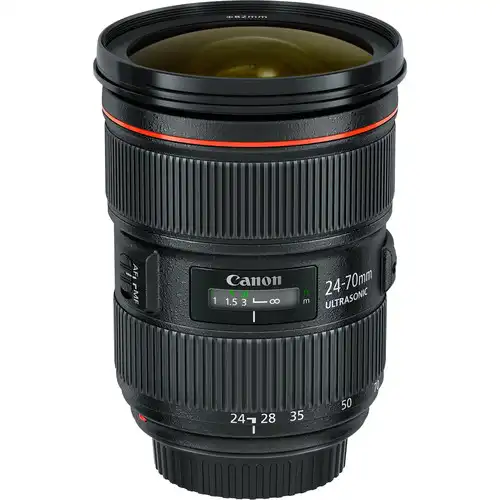
The Canon EF 24-70mm f/2.8L II USM stands as a quintessential professional standard zoom lens within Canon's esteemed L-series lineup. Designed for full-frame EF-mount DSLR cameras, this lens is lauded for its versatility, robust construction, and impressive optical performance, establishing itself as a workhorse for a wide array of photographic disciplines. Its constant f/2.8 maximum aperture across the entire 24-70mm focal range further cements its status as a preferred choice for professionals requiring consistent light gathering capabilities and depth of field control.
Optically, the EF 24-70mm f/2.8L II USM exemplifies the high standards expected from Canon's L-series. The intricate optical design incorporates 18 elements in 13 groups, featuring both aspherical and Ultra-low Dispersion (UD) elements. These specialized optics are crucial in mitigating various aberrations, including spherical aberration and chromatic aberration, resulting in images characterized by excellent sharpness, clarity, and color fidelity from edge to edge. Users can expect consistently high resolution throughout the zoom range, particularly when stopped down slightly from the maximum aperture, though performance remains strong even wide open at f/2.8. The nine-blade circular diaphragm contributes to a pleasing bokeh quality, rendering smooth, natural out-of-focus backgrounds, which is particularly beneficial for portraiture and isolating subjects. While optical corrections are highly effective, a degree of barrel distortion may be observed at the widest end (24mm) and some pincushion distortion at the telephoto end (70mm), alongside minor vignetting at f/2.8, which are common characteristics of fast zoom lenses and are often easily correctable in post-processing.
Autofocus performance is another strong suit of this lens, thanks to its ring-type Ultrasonic Motor (USM). This system delivers fast, accurate, and remarkably quiet autofocus, making it highly reliable in dynamic shooting environments. The USM allows for full-time manual focus override, providing photographers with instantaneous control without needing to switch out of AF mode, a critical feature for fine-tuning focus in precise situations. The responsiveness and precision of the autofocus system ensure that crucial moments are captured with sharp clarity, even in challenging lighting conditions where its f/2.8 aperture allows more light to reach the sensor, aiding AF sensitivity.
The build quality of the EF 24-70mm f/2.8L II USM is commensurate with its L-series designation. Constructed to withstand the rigors of professional use, it features a durable, weather-sealed design. This weather sealing provides enhanced resistance to dust and moisture, making the lens a dependable companion for outdoor shoots or adverse weather conditions. Weighing 805 grams and with an 82mm filter thread, it feels substantial and well-balanced on professional DSLR bodies. The zoom and focus rings operate smoothly and precisely, conveying a sense of quality and reliability in hand. The minimum focus distance of 0.38 meters and a maximum magnification of 0.21x offer respectable close-up capabilities, allowing for detailed shots of smaller subjects within its versatile range.
This lens truly excels in a multitude of use cases, making it a highly valuable asset for a diverse range of photographers:
- Event Photography and Photojournalism: The constant f/2.8 aperture is invaluable for shooting in varying and often low-light conditions typically encountered at events or in photojournalistic assignments. Its fast autofocus and versatile zoom range allow photographers to adapt quickly to unfolding scenes, capturing everything from wide establishing shots to tighter portraits without needing to change lenses.
- Wedding Photography: For wedding photographers, the 24-70mm f/2.8L II USM is often considered a staple. It covers essential focal lengths for ceremony shots, portraits, group photos, and reception candids. The beautiful bokeh at f/2.8 helps isolate subjects, and its low-light performance is crucial for dimly lit venues.
- Portraiture: While often associated with prime lenses, the 24-70mm f/2.8's ability to render pleasing bokeh and its sharp output make it an excellent choice for environmental and full-body portraits. The 70mm end, combined with f/2.8, provides sufficient subject separation and a natural perspective.
- Landscape Photography: The 24mm wide end is ideal for capturing expansive vistas, while the ability to zoom to 70mm offers flexibility for compositional refinement or isolating specific elements within a scene. Its excellent sharpness ensures intricate details are rendered clearly across the frame.
- Travel Photography: The single-lens versatility of the 24-70mm range reduces the need to carry multiple prime lenses, making it a convenient choice for travel. Its robust, weather-sealed build also provides peace of mind when exploring diverse environments.
Despite its many strengths, it is important to acknowledge certain considerations. One of the most frequently cited points is the absence of optical image stabilization (IS). While the f/2.8 aperture helps in low light by allowing faster shutter speeds, users may find the lack of IS noticeable when shooting handheld at slower shutter speeds, especially towards the 70mm end, or when capturing video. This requires careful attention to shutter speed choices or the use of a tripod in challenging light. Additionally, its professional-grade construction translates to a relatively heavy and substantial lens, which might be a factor for photographers prioritizing lightweight setups for extended handheld shooting or travel.
In conclusion, the Canon EF 24-70mm f/2.8L II USM remains an outstanding standard zoom lens, representing a significant investment for professionals and serious enthusiasts. Its combination of superb optical quality, consistent f/2.8 aperture, rapid and reliable autofocus, and rugged build quality makes it an indispensable tool for a vast array of photographic genres. While the absence of image stabilization is a notable omission compared to some contemporary designs or alternatives, its core performance attributes ensure it continues to be a top-tier choice for those operating within the Canon EF DSLR ecosystem, where versatility and uncompromising image quality are paramount.