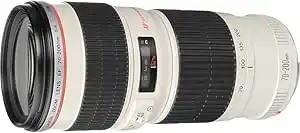
The Canon EF 70-200mm f/4L USM is a distinguished member of Canon's professional L-series lens lineup, known for its enduring optical and mechanical design. This full-frame compatible telephoto zoom for the EF mount balances high-end performance, robust construction, and a relatively accessible form factor. It provides L-series quality without the added bulk or cost often associated with faster f/2.8 versions or image-stabilized models. This review will explore its capabilities, performance, and ideal applications, offering a balanced perspective on its utility.
The EF 70-200mm f/4L USM's optical design, featuring 16 elements in 13 groups, underpins its reputation for exceptional image quality across the 70-200mm focal range. Expect sharp, contrast-rich images with accurate color rendition, a hallmark of L-series optics. Chromatic aberrations are well-controlled, and distortion is minimal. The constant f/4 maximum aperture across the zoom range is a significant practical advantage, allowing consistent exposure settings during dynamic shooting. While f/4 doesn't offer the extreme shallow depth of field of an f/2.8 lens, it can still produce pleasing subject isolation, especially at longer focal lengths. The 8-blade circular diaphragm contributes to a relatively smooth bokeh. For landscape photographers, who often shoot at smaller apertures, f/4 is entirely suitable, providing crisp details edge-to-edge.
Equipped with Canon’s Ultrasonic Motor (USM) technology, the EF 70-200mm f/4L USM delivers swift, quiet, and precise autofocus. This ring-type USM system allows full-time manual focus override, enabling fine-tuning without switching AF modes. The speed and accuracy of the USM make this lens highly capable for capturing fast-moving subjects, essential for sports, wildlife, and event photography. Its internal focusing mechanism prevents the front element from rotating, beneficial when using filters. Consistent autofocus, even in moderately challenging lighting, solidifies its professional-grade credentials.
As an L-series lens, the EF 70-200mm f/4L USM adheres to demanding professional standards. Its robust construction features a durable metal mount and a high-quality barrel. Crucially, it boasts weather-sealed construction, offering resistance against dust and moisture, providing peace of mind in less-than-ideal conditions. Weighing 705 grams, it is notably lighter and more compact than its f/2.8 counterparts, making it more manageable for extended handheld shooting or travel. The 67mm filter thread is a common size, enhancing filter versatility. Its internal zoom design maintains consistent physical length, contributing to balance and sealing integrity.
A defining characteristic of this specific EF 70-200mm f/4L USM model is the absence of built-in image stabilization. This original version relies on photographer technique or tripod use to mitigate camera shake. This omission is a key consideration. For handheld shooting, especially at 200mm or in lower light, photographers need faster shutter speeds or higher ISO to maintain sharpness. This makes the lens less forgiving in low-light or tripod-impractical scenarios. For landscape photography, where tripods are common, or outdoor sports under bright conditions, lack of IS is often a non-issue. However, for event photography in dim venues or handheld wildlife, it demands careful shutter speed discipline.
The 70-200mm focal range, combined with its optical quality, positions this lens as an excellent tool for various photographic disciplines:
- Portrait Photography: Telephoto compression and subject separation are highly suitable, offering flattering perspectives for various portrait compositions. The f/4 aperture provides sufficient depth control.
- Sports Photography: For outdoor sports or well-lit indoor events, the fast USM autofocus excels at tracking athletes. Its reach is adequate for many field-side situations, though f/4 may require higher ISOs in dim stadiums, and lack of IS might be felt when panning.
- Event Photography: From concerts to corporate gatherings, the lens offers valuable reach for candid moments. Its relatively compact size makes it less obtrusive. Awareness of ambient light and shutter speed is crucial without IS.
- Wildlife Photography: While 200mm is often short for serious wildlife, it provides valuable reach for larger animals or when reasonably close. Rapid autofocus benefits fleeting moments. For static subjects or tripod-mounted shots, optical quality is rewarding.
- Landscape Photography: This lens excels in landscape applications. Its ability to compress perspective and capture intricate details across vast scenes is remarkable. Since landscapes are often shot at narrower apertures, f/4 is entirely adequate, and the lens's sharpness across the frame is a significant asset. Its lighter weight is also a distinct advantage for hiking.
The EF 70-200mm f/4L USM's primary strengths include exceptional optical quality, consistent f/4 aperture, reliable USM autofocus, and robust L-series build with weather sealing. Its lightweight and compact design enhances portability, distinguishing it from heavier f/2.8 models. This balance of performance and portability, often found at an accessible price, makes it a highly attractive option.
However, the lack of image stabilization is its most significant consideration. Photographers frequently shooting handheld in low light or requiring slow shutter speeds might find this limiting, potentially leading to increased ISO or greater tripod reliance. The f/4 maximum aperture, while constant, doesn't offer the extreme background blur or light-gathering capabilities of an f/2.8 lens, which could be a factor for very shallow depth-of-field portraits or extremely dark indoor events. Its maximum magnification of 0.16x confirms it's not a macro lens.
The Canon EF 70-200mm f/4L USM remains an outstanding telephoto zoom for Canon EF mount DSLR users. It's a classic L-series workhorse, delivering professional-grade optical performance and robust construction in a portable, value-oriented package. While lacking image stabilization and a wider aperture than some counterparts, its strengths in sharpness, AF speed, and build quality make it an exceptionally capable tool for a broad spectrum of genres, including portraits, outdoor sports, events, wildlife, and especially landscape photography. For photographers prioritizing optical excellence and rugged dependability, and mindful of its IS limitation, this lens continues to be a highly respected and recommended choice, offering superb results without the prohibitive cost or weight often associated with top-tier professional telephoto zooms.