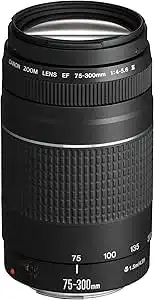
The Canon EF 75-300mm f/4-5.6 III lens stands as a widely recognized and often entry-level telephoto zoom option within Canon's extensive EF-mount ecosystem. Designed for full-frame DSLR cameras, this lens offers a considerable zoom range, stretching from a moderate 75mm telephoto to a significant 300mm super-telephoto perspective. Its enduring presence in the market is largely attributable to its accessible price point, positioning it as a popular choice for photographers seeking extended reach without a substantial investment. This review aims to provide an objective assessment of its capabilities, design, and most suitable applications, acknowledging its place as a budget-friendly workhorse rather than a premium optical instrument.
At the core of the EF 75-300mm f/4-5.6 III's appeal is its versatile focal length. The 75mm end is ideal for portraiture, isolating subjects, or compressing perspective slightly, while the 300mm end provides substantial magnification, bringing distant subjects much closer. This broad range makes it a compelling choice for various types of photography where proximity to the subject is not always possible or desired. For "Casual Wildlife Photography," the 300mm reach can be invaluable for capturing birds, animals, or other fauna from a respectful distance, though its aperture and autofocus limitations might challenge more demanding scenarios. Similarly, in "Casual Sports Photography," it allows photographers to frame action across a field or court, making it suitable for capturing school sports or less critical events where subject speed and lighting conditions are manageable. Its relatively lightweight build at 480g also contributes to its "Travel Photography" suitability, making it less cumbersome to carry than heavier, professional-grade telephoto lenses, allowing for spontaneous captures of landscapes, architecture details, or street scenes from afar. Ultimately, for any application involving "Distance Subjects," the lens delivers the necessary focal power.
Optically, the Canon EF 75-300mm f/4-5.6 III is constructed with 13 elements arranged in 9 groups. This configuration is fairly standard for a telephoto zoom in its class. The maximum aperture varies across the zoom range, starting at f/4 at the 75mm end and closing down to f/5.6 by 300mm. This variable maximum aperture is a common characteristic of budget-friendly zoom lenses and means that the lens gathers less light at its longer focal lengths, necessitating higher ISOs or slower shutter speeds in dim conditions. While its f/32-45 minimum aperture allows for extensive depth of field, it is less frequently used. The 7-blade diaphragm contributes to a reasonably pleasing out-of-focus background, or bokeh, when used at wider apertures, although the inherent nature of its maximum aperture won't produce the shallowest depth of field characteristic of faster prime or professional zoom lenses.
One significant consideration is the absence of image stabilization. For a lens with a maximum focal length of 300mm, image stabilization is highly beneficial, especially when shooting handheld or in lower light. Without it, photographers will need to employ faster shutter speeds (typically 1/focal length or faster) or rely on a tripod to minimize camera shake and achieve sharp images, particularly at the longer end of the zoom. This factor directly impacts its performance in situations like casual wildlife or sports, where conditions can be unpredictable and stable platforms aren't always available.
The lens features a DC Autofocus Motor. While functional and generally reliable for most static or slow-moving subjects, it is not as fast, quiet, or precise as Canon's more advanced Ultrasonic Motor (USM) found in higher-end EF lenses. This means that for fast-paced action or critical focus requirements, the autofocus can sometimes hunt or be slower to acquire focus, particularly in challenging light. The minimum focus distance of 1.5 meters (approximately 4.9 feet) allows for a maximum magnification of 0.25x, which is adequate for basic close-up work but doesn't venture into true macro territory. A 58mm filter thread is a common size, making it easy to find compatible filters.
In terms of build quality and handling, the EF 75-300mm f/4-5.6 III is lightweight and predominantly constructed from plastic, consistent with its budget positioning. While it feels solid enough for casual use, it lacks the weather sealing and robust feel of professional lenses. Its compact size for a telephoto zoom (considering its reach) enhances its portability, making it a good companion for travel or day trips where minimizing bulk is a priority.
In conclusion, the Canon EF 75-300mm f/4-5.6 III is a lens that primarily excels as an affordable gateway to telephoto photography. It offers an impressive focal range for its price, making it highly suitable for casual photographers interested in capturing distant subjects in bright conditions. Its strengths lie in its accessibility, light weight, and the sheer reach it provides for general "Distance Subjects," "Travel Photography," and entry-level "Wildlife" or "Sports Photography." However, potential users should be mindful of its limitations: the variable and relatively slow maximum aperture, the lack of image stabilization, and the DC autofocus motor's performance. For those on a tight budget or beginners exploring the telephoto realm, this lens offers a practical and cost-effective means to expand their photographic capabilities, provided expectations are aligned with its market segment.