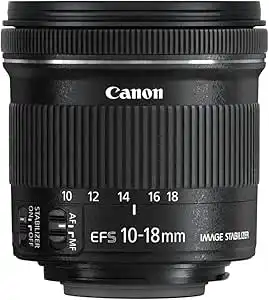
The Canon EF-S 10-18mm f/4.5-5.6 IS STM lens represents a significant offering for photographers using Canon's APS-C DSLR cameras. Positioned as an affordable yet capable ultra-wide zoom, it aims to unlock expansive perspectives for a broad audience. Designed exclusively for the EF-S mount, its 10-18mm focal range translates to an effective 16-29mm field of view on a full-frame sensor, providing genuinely wide-angle capabilities. The inclusion of Optical Image Stabilization (IS) and a quiet Stepping Motor (STM) for autofocus are key features that underscore its versatility for both still photography and video recording, particularly for content creators.
Design and Ergonomics Weighing a mere 240 grams, the EF-S 10-18mm is remarkably lightweight and compact, making it an ideal companion for travel or extended shooting sessions where minimizing bulk is crucial. This low weight is primarily due to its predominantly plastic construction, including the lens mount. While this might suggest a less premium feel compared to professional-grade lenses, the build quality is sturdy enough for its intended consumer market, contributing significantly to its portability. The compact dimensions, with a 67mm filter thread, ensure it balances comfortably on smaller APS-C bodies. Both the zoom and manual focus rings operate smoothly, although the focus-by-wire system for manual focusing lacks the direct tactile feedback of mechanically coupled designs.
Optical Characteristics The lens's defining feature is its ultra-wide 10-18mm focal length. At 10mm, it delivers a dramatic, expansive field of view, adept at capturing vast landscapes or the entirety of an interior space. Zooming to 18mm provides a still-wide, yet slightly more conventional, perspective, suitable for a range of scenes from group photos to street photography. The maximum aperture of f/4.5 at 10mm, gradually narrowing to f/5.6 at 18mm, is characteristic of consumer-grade ultra-wide zooms, balancing cost and size with light-gathering capability. Its minimum aperture ranges from f/22 to f/29. The optical formula comprises 14 elements in 11 groups, including one UD (Ultra-low Dispersion) element and one Aspherical element, which are crucial for correcting various optical aberrations across such a broad focal range. A 7-blade rounded diaphragm helps to produce smoother out-of-focus areas, though significant background blur is rarely the primary objective with an ultra-wide lens.
Image Quality Assessment For its price point, the EF-S 10-18mm delivers commendable image quality. Sharpness is generally very good in the center of the frame, especially when stopped down slightly from the maximum aperture. Performance typically remains solid into the mid-frame, with the extreme corners showing some degree of softness, particularly at 10mm and wider apertures. Optimal sharpness across the frame is usually achieved by stopping down to f/8 or f/11. Distortion, an inherent challenge for ultra-wide lenses, is present. Barrel distortion is noticeable at the 10mm end, gradually transitioning to pincushion distortion as the lens zooms towards 18mm. However, the specialized UD and Aspherical elements help to manage these aberrations reasonably well for a lens in this class. In-camera corrections (for JPEGs) and readily available lens profiles in post-processing software (for RAW files) make distortion correction straightforward and effective. Chromatic aberrations are generally well-controlled, particularly due to the UD element, though some minor fringing can be observed at the edges in high-contrast situations. Vignetting is most apparent at the widest focal lengths and largest apertures but typically diminishes when stopped down or can be easily corrected digitally. The Super Spectra Coating works effectively to suppress flare and ghosting, maintaining contrast and color fidelity even when shooting towards bright light sources, though direct sunlight can still produce some artifacts.
Autofocus and Image Stabilization A significant asset of this lens is its STM (Stepping Motor) autofocus system. The STM provides exceptionally quiet and smooth focusing, a critical advantage for video recording. This near-silent operation ensures that autofocus noise is not captured by the camera's microphone, making it an excellent choice for vlogging and other video content creation. For still photography, the STM motor delivers reasonably quick and accurate autofocus in most lighting conditions, though it may exhibit some hunting in very low light. The lens features a minimum focus distance of 0.22 meters, allowing for some creative close-up wide-angle perspectives, achieving a maximum magnification of 0.15x. The inclusion of Optical Image Stabilization (IS) is another major selling point, especially considering the lens's variable and relatively modest maximum aperture. Canon claims up to four stops of correction, which is a substantial benefit for handheld shooting in challenging light. This allows photographers to use slower shutter speeds without increasing ISO dramatically, resulting in cleaner images with less noise. The IS system is highly effective, visibly steadying the viewfinder image and producing sharper results, which is invaluable for interior shots, low-light landscapes, and steady handheld video.
Core Use Cases The EF-S 10-18mm f/4.5-5.6 IS STM truly excels in several key photographic genres:
- Landscape Photography: Its ultra-wide perspective is perfect for capturing sweeping natural vistas, dramatic skies, and expansive outdoor scenes, allowing photographers to emphasize the grandeur of their surroundings.
- Architecture Photography: This lens is an invaluable tool for documenting both exterior and interior architecture, fitting entire buildings, intricate structures, or large rooms into a single frame.
- Interior Photography: In confined spaces, the 10mm end is particularly useful for capturing the full scope of a room or tight interiors without being physically constrained.
- Vlogging: The wide field of view is excellent for self-recording, ensuring the subject and a significant portion of the background are in frame. The quiet STM autofocus and effective IS further enhance its suitability for video content creators.
- Group Photos: When photographing large groups, especially in limited spaces, the wide angle makes it easy to include everyone without needing to step back excessively.
- Travel Photography: Its lightweight and compact nature, combined with its versatile ultra-wide perspective, makes it an ideal lens to pack for exploring new destinations, from bustling cityscapes to natural wonders.
Limitations and Value Proposition While offering excellent value, the lens does have inherent limitations. Its variable maximum aperture of f/4.5-5.6 means it is not a fast lens, posing challenges in very low-light environments where higher ISO settings may be necessary. Consequently, it is less suited for achieving significant background blur or subject isolation. The plastic mount, while contributing to its low weight, might be a consideration for users demanding ultimate long-term durability under extremely heavy professional use, though it is generally robust for consumer applications.
Conclusion The Canon EF-S 10-18mm f/4.5-5.6 IS STM is an outstanding and accessible ultra-wide-angle zoom lens for Canon APS-C DSLR users. It strikes an impressive balance between performance, features, and affordability. Its compelling combination of a genuinely wide zoom range, effective optical image stabilization, and quiet STM autofocus makes it a highly recommended and value-driven choice for those looking to expand their creative horizons in landscape, architecture, interior, and travel photography, as well as for aspiring vloggers.