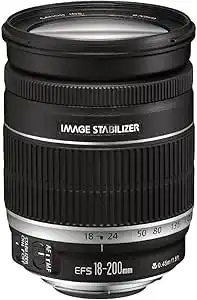
The Canon EF-S 18-200mm f/3.5-5.6 IS stands as a prime example of an "all-in-one" superzoom lens, designed specifically for Canon's APS-C format EF-S mount DSLR cameras. Launched to offer unparalleled versatility in a single package, this lens aims to reduce the need for multiple lenses, making it an appealing option for photographers seeking convenience without frequently changing optics.
At the heart of its appeal is the expansive 18-200mm focal range. This broad spectrum covers everything from wide-angle landscapes and interior shots at 18mm (equivalent to approximately 29mm on a full-frame sensor) to considerable telephoto reach at 200mm (equivalent to approximately 320mm). This capability makes the lens exceptionally well-suited for a wide array of photographic disciplines, making it a true workhorse for many users.
For Travel Photography, the 18-200mm f/3.5-5.6 IS excels by providing an extensive focal range that can capture sweeping vistas, architectural details, street scenes, and even distant subjects like wildlife without the burden of carrying or switching between several lenses. This convenience is paramount for photographers on the go, allowing them to react quickly to diverse photographic opportunities. Similarly, for Everyday Photography, its versatility means it can handle a spontaneous portrait, a group shot, or a detail capture with equal ease, making it an ideal "walk-around" lens that can stay on the camera for most situations.
Landscape Photography benefits from the 18mm wide-angle end, allowing for broad scenic views. While prime lenses or dedicated wide-angle zooms might offer superior edge-to-edge sharpness, the 18-200mm provides a respectable performance for general landscape use, especially when convenience is prioritized. Moving to Portrait Photography, the longer end of the zoom, particularly around 85-135mm (effective 136-216mm), can provide a flattering perspective for subjects, and while the variable aperture of f/3.5-5.6 limits extreme background blur, it can still achieve a pleasing separation, especially at 200mm. For opportunistic Wildlife Photography, the 200mm telephoto reach offers a significant advantage, allowing photographers to capture distant animals without disturbing them, an invaluable asset for hobbyists or casual encounters.
Optically, the lens incorporates 16 elements in 12 groups, a complex arrangement necessary to manage such a wide zoom range. A key feature is the built-in Image Stabilization (IS) system, which offers several stops of compensation, significantly aiding in sharper handheld shots, particularly at longer focal lengths or in challenging low-light conditions where a tripod is impractical. This is a crucial addition for a superzoom, mitigating the effects of camera shake and allowing for slower shutter speeds.
The variable maximum aperture of f/3.5-5.6 is typical for lenses of this type and focal range. While it provides adequate light gathering in well-lit environments, its relatively modest maximum aperture can present limitations in low-light situations, potentially necessitating higher ISO settings or slower shutter speeds. The minimum aperture ranges from f/22 to f/38, offering extensive depth of field when required. The diaphragm features 6 blades, which contributes to a reasonably pleasing, though not exceptionally smooth, bokeh.
Autofocus performance, while not class-leading in speed compared to lenses with USM or STM motors, is generally reliable for most static and moderately moving subjects. The minimum focus distance of 0.45 meters (1.5 feet) across the entire zoom range, coupled with a maximum magnification of 0.24x, allows for decent close-up capabilities, though it's not a dedicated macro lens.
In terms of physical attributes, the Canon EF-S 18-200mm f/3.5-5.6 IS is designed with portability in mind. Weighing in at 595 grams (approximately 1.3 lbs), it is relatively lightweight for its comprehensive zoom range, making it comfortable to carry for extended periods. Its compact form factor further contributes to its suitability as a travel and everyday lens. The 72mm filter thread is a common size, making it easy to find and use various filters.
However, as with all superzoom lenses, compromises are inherent to achieve such extensive versatility. While generally good for its class, optical performance across the entire 18-200mm range may not match the sharpness or control of distortion and chromatic aberration found in specialized prime lenses or professional-grade zooms. Users might observe some softness at the extreme ends of the zoom range, particularly wide open, and some barrel distortion at 18mm and pincushion distortion at the telephoto end. Chromatic aberration can also be present, though often correctable in post-processing. These are expected trade-offs for the convenience offered.
In conclusion, the Canon EF-S 18-200mm f/3.5-5.6 IS stands as a highly practical and versatile lens for Canon APS-C DSLR users. It particularly excels in scenarios where convenience, a broad focal range, and the ability to adapt to diverse shooting conditions are paramount. For travel, everyday shooting, and capturing a wide spectrum of subjects from landscapes to opportunistic portraits and wildlife, its combination of extensive zoom and effective image stabilization makes it a compelling "one-lens solution," offering significant value despite the expected optical compromises inherent in its superzoom design.