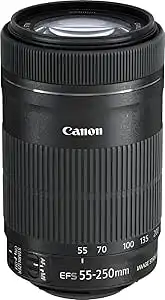
The Canon EF-S 55-250mm f/4-5.6 IS STM lens stands as a compelling telephoto zoom option for Canon's APS-C DSLR camera system. Designed as a natural progression from the standard 18-55mm kit lens, it extends a photographer's reach significantly, offering a versatile range that covers everything from detailed distant subjects to tighter portraits. This lens aims to strike a commendable balance between performance, features, and affordability, making it particularly attractive to enthusiasts, students, and those entering the realm of telephoto photography.
From a physical standpoint, the EF-S 55-250mm IS STM is notably compact and lightweight for a lens of its focal range, tipping the scales at just 375 grams. Its predominantly plastic construction contributes to this portability, a trade-off that is common in lenses designed for the consumer market. While not exuding the ruggedness of professional-grade L-series optics, its build quality is perfectly adequate for everyday use and travel. The 58mm filter thread is a common size, allowing for easy sharing of filters with many other kit or budget lenses. The lens does extend physically as it zooms towards the 250mm mark, but this is a standard characteristic for many zoom lenses in its class.
Optically, the lens is comprised of 15 elements in 12 groups, including one Ultra-low Dispersion (UD) glass element. The inclusion of a UD element is a significant feature at this price point, specifically designed to reduce chromatic aberrations and improve overall image clarity and color accuracy across the zoom range. In terms of sharpness, the lens performs admirably, particularly in the center of the frame, throughout much of its focal range. At wider apertures and longer focal lengths, some softness may become apparent towards the edges and corners, a common characteristic of variable-aperture consumer zoom lenses. Stopping down slightly, typically to f/8 or f/11, can often yield sharper results across the frame. Distortion is generally well-controlled, with some pincushion distortion noticeable at the telephoto end, which is easily correctable in post-processing if desired. Vignetting is present at wider apertures, especially at 55mm, but it diminishes quickly when stopped down or at longer focal lengths. With its 7-blade circular diaphragm, the lens produces reasonably smooth and pleasing bokeh, particularly when shooting at 250mm with subjects isolated from their background, creating a gentle out-of-focus rendition suitable for portraits.
One of the most significant advancements in this iteration of the 55-250mm lens is the inclusion of a Stepping Motor (STM) autofocus system, specifically a lead-screw-type STM. This motor provides exceptionally smooth and quiet autofocus operation, a feature that profoundly benefits video shooters. The near-silent focusing ensures that the camera's microphone does not pick up distracting motor noise during recording. For still photography, the STM motor delivers quick and accurate autofocus performance in most well-lit conditions. While perhaps not as blazingly fast as Canon's more advanced USM (Ultrasonic Motor) systems for tracking incredibly erratic or fast-moving subjects, it is more than sufficient for general photography, including action at a reasonable pace.
Complementing the STM motor is Canon's highly effective Image Stabilization (IS) system. With a telephoto lens, camera shake becomes increasingly pronounced as focal length increases, making IS an indispensable feature. The system in this lens is rated to provide approximately 3.5 to 4 stops of shake correction, significantly aiding in capturing sharp images in challenging lighting conditions or at slower shutter speeds than would otherwise be possible handheld. This is particularly valuable when shooting handheld at the longer end of the zoom, or in situations where a tripod isn't feasible. For video, the IS also contributes to smoother, less shaky footage.
The Canon EF-S 55-250mm f/4-5.6 IS STM excels in several practical use cases:
- Telephoto and Wildlife Photography: Its extended reach (equivalent to approximately 88-400mm on a full-frame camera) makes it an excellent choice for capturing distant subjects, such as wildlife or scenic landscapes. The IS system is crucial here, helping to maintain sharpness when hand-holding at 400mm equivalent. While the f/5.6 maximum aperture at 250mm might limit its performance in very low light conditions, it remains a highly capable lens for entry-level wildlife photography in good light.
- Sports Photography: For well-lit outdoor sporting events, the 250mm end provides sufficient reach to get closer to the action. The STM autofocus, while not top-tier for professional sports, is responsive enough for many amateur sports scenarios, and the image stabilization helps freeze movement, especially for subjects that are not moving excessively fast or erratically.
- Travel Photography: Its lightweight and compact design, combined with its versatile focal range, makes it an ideal companion for travel. It allows photographers to capture sweeping landscapes, architectural details, and candid moments without carrying heavy equipment.
- Portrait Photography: At 250mm, the lens offers excellent subject compression, which is highly desirable for flattering portraits. While its maximum aperture of f/5.6 at this focal length isn't as wide as dedicated portrait primes, the combination of focal length and a decent working distance can still produce pleasing subject isolation and background blur, especially for headshots and tighter compositions.
In conclusion, the Canon EF-S 55-250mm f/4-5.6 IS STM is a highly recommended telephoto zoom lens for Canon APS-C DSLR users seeking an affordable yet capable option. It delivers a versatile focal range, effective image stabilization, and a smooth, quiet STM autofocus system that significantly enhances both still photography and video recording experiences. While its variable and somewhat slow maximum aperture is a natural limitation that demands careful consideration in low-light environments, its overall performance, lightweight design, and excellent value for money solidify its position as a go-to lens for beginners and enthusiasts looking to expand their photographic horizons into the telephoto realm.