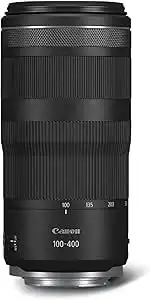
The Canon RF 100-400mm f/5.6-8 IS USM lens emerges as a compelling telephoto zoom option within Canon's burgeoning RF mirrorless system. Positioned as an accessible and highly portable solution, it aims to deliver substantial telephoto reach without the bulk or prohibitive cost often associated with such lenses. Designed for full-frame RF cameras, this lens is engineered to appeal to a broad spectrum of photographers, from enthusiasts venturing into wildlife and sports to travelers seeking a versatile optic for distant subjects. Its unique blend of reach, advanced features, and a remarkably lightweight design makes it a standout choice for those prioritizing portability and value in their telephoto toolkit.
At its core, the RF 100-400mm f/5.6-8 IS USM provides a highly versatile focal length range, extending from a modest 100mm to a powerful 400mm. This makes it adept at capturing a wide variety of subjects, from distant landscapes and architectural details to elusive wildlife and fast-paced sporting action. The variable maximum aperture of f/5.6 at 100mm, narrowing to f/8 at 400mm, is a primary factor in the lens's compact dimensions and lighter weight. While this aperture range may present challenges in extremely low-light conditions, it is a deliberate engineering trade-off that significantly enhances portability. The minimum aperture range extends to f/32-45, offering extensive depth of field control when desired.
Optically, the lens incorporates 17 elements arranged in 12 groups, a complex construction designed to mitigate aberrations across its expansive zoom range. Canon has included both a Super UD (Ultra Low Dispersion) element and a standard UD element, specifically targeted at correcting chromatic aberrations and color fringing, which can be particularly noticeable in telephoto lenses. While not a professional L-series lens, the optical performance is generally commendable, delivering respectable sharpness and detail, especially in well-lit scenarios. Distortion and vignetting are present but generally well-controlled, and in-camera corrections available on RF bodies can further refine these aspects. The 9-blade circular aperture contributes to a pleasing bokeh quality, allowing for smooth background blur when isolating subjects.
The autofocus system is powered by Canon's Nano USM (Ultrasonic Motor), a technology lauded for its speed, quietness, and smoothness. This makes the RF 100-400mm f/5.6-8 IS USM highly capable for both still photography and video recording. The swift and near-silent operation is particularly beneficial for wildlife and bird photography, where minimizing disturbance is crucial. For sports and action, the Nano USM provides reliable tracking capabilities, helping photographers keep pace with rapidly moving subjects. The minimum focus distance of 0.88 meters across the zoom range, combined with a maximum magnification of 0.41x at 400mm, offers a surprisingly close focusing ability, allowing for detailed close-up shots of smaller subjects like insects or flowers, adding another layer of versatility to its repertoire.
One of the lens's most compelling features is its highly effective Image Stabilization (IS) system, which Canon specifies offers up to 5.5 stops of correction. This is an invaluable asset, especially when shooting at longer focal lengths or in challenging light conditions, enabling sharper handheld shots at slower shutter speeds than would otherwise be possible. When combined with in-body image stabilization (IBIS) found in many RF camera bodies, the synergistic effect can further enhance stability, making it easier to achieve crisp images and smooth video.
In terms of build and handling, the RF 100-400mm is remarkably compact and lightweight for a lens of its focal length. Weighing in at just 635 grams and featuring a manageable 67mm filter thread, it is a lens that can be comfortably carried for extended periods, making it ideal for travel and prolonged field excursions. The inclusion of a customizable Control Ring, a signature feature of RF lenses, provides an intuitive way to adjust various camera settings directly from the lens, enhancing the user experience. While its construction is not as robust as L-series lenses, it feels solid enough for its intended use, focusing on balancing durability with its light build.
This lens truly excels across several distinct use cases. For Wildlife and Bird Photography, its 400mm reach is foundational, allowing photographers to capture distant subjects without encroachment. The effective image stabilization is critical for maintaining sharpness when hand-holding, and the quiet Nano USM minimizes disturbance. While the f/8 maximum aperture at 400mm might necessitate higher ISO settings in dimmer conditions, it remains highly capable in good light, offering an accessible entry point into these demanding genres.
Sports Photography, particularly outdoor events with ample light, is another strong suit. The rapid autofocus tracking can lock onto moving athletes, while the 400mm end provides sufficient reach for many field sports. Its lighter weight is a significant advantage for photographers who spend hours tracking action, reducing fatigue.
For Nature Photography, beyond just wildlife, the lens is incredibly versatile. It can compress landscapes, capture intricate details of plants or geology from a distance, and its close-focusing capabilities allow for compelling close-ups. Its portability makes it an excellent companion for long hikes or backcountry trips.
Finally, for Travel Photography, the RF 100-400mm f/5.6-8 IS USM is an exceptional choice. Its compact design means it won't be a burden in a travel bag, yet it provides the indispensable telephoto reach for capturing distant landmarks, street scenes from afar, or unique wildlife encounters that may arise. It allows photographers to react quickly to diverse photographic opportunities without needing to carry heavier, more specialized equipment.
In conclusion, the Canon RF 100-400mm f/5.6-8 IS USM is a well-considered lens that prioritizes reach and portability within the Canon RF ecosystem. While its variable and somewhat slower maximum aperture is a notable compromise, it is a deliberate design choice that enables its compact size, light weight, and accessible price point. Its strong image stabilization, fast Nano USM autofocus, and versatile focal range make it an excellent tool for wildlife, sports, nature, and travel photographers seeking a balanced, highly functional, and manageable telephoto zoom solution for their Canon RF mirrorless cameras. It represents a sensible and practical option for photographers who value flexibility and ease of use in their pursuit of distant subjects.