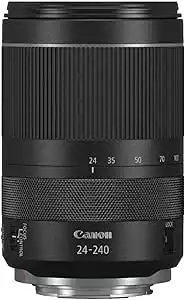
The Canon RF 24-240mm f/4-6.3 IS USM represents a compelling offering within Canon's burgeoning RF mirrorless system, designed for photographers who prioritize versatility and convenience above all else. This "all-in-one" superzoom lens covers an expansive 10x focal range, from a wide 24mm to a substantial 240mm telephoto, positioning it as an ideal single-lens solution for a myriad of shooting scenarios. Its design ethos centers on adaptability, making it particularly attractive to travel photographers, casual shooters, and those looking for a comprehensive everyday lens that avoids the need for frequent lens changes.
From a design perspective, the RF 24-240mm integrates seamlessly with Canon's full-frame RF mirrorless cameras. Despite its impressive focal range, it maintains a relatively manageable weight of 750g, making it a comfortable companion for extended shooting sessions or when packed in a camera bag. The build quality feels robust enough for its target market, though it might not exude the premium feel of some L-series lenses. A notable feature is the customizable Control Ring, a hallmark of the RF system, which can be assigned to adjust aperture, ISO, or exposure compensation, providing a tactile and intuitive control point that enhances the user experience. The 72mm filter thread is a common size, allowing for easy integration of various filters.
The colossal 24-240mm focal range is undoubtedly this lens's headline feature. At 24mm, it provides a genuinely wide perspective, excellent for sweeping landscapes, architectural shots, and group photos where space is limited. It offers ample coverage to capture immersive scenes without needing to step back. As you zoom through the mid-ranges (e.g., 50mm, 70mm, 100mm), the lens transitions smoothly into focal lengths ideal for street photography, environmental portraits, and general everyday shooting, offering a natural perspective that is highly versatile. Pushing further to the telephoto end, the 240mm reach is substantial. It allows photographers to capture distant subjects, whether it's wildlife from afar (though not for serious wildlife work requiring faster apertures or longer reach), action at sporting events, or isolating details in a landscape. The convenience of having this entire range in a single optic means fewer missed shots due to lens changes and a lighter travel kit.
However, the expansive zoom range comes with an inherent trade-off in the form of its variable maximum aperture of f/4-6.3. At the wide end, f/4 is respectable for daylight conditions, but it quickly narrows to f/6.3 as you zoom towards the telephoto limit. This characteristic limits the lens's performance in low-light environments, requiring higher ISO settings or slower shutter speeds, and also restricts the ability to achieve significant background blur (bokeh) for subject isolation, especially at the wider end. While the 7-blade diaphragm can produce reasonably pleasing out-of-focus areas when subjects are close and backgrounds are distant at the telephoto end, it won't rival the creamy bokeh of faster prime lenses.
To mitigate the challenges posed by the slower aperture and the potential for camera shake, especially at longer focal lengths, Canon has integrated effective Image Stabilization (IS) into the lens. This optical IS system is a critical component, offering several stops of correction, which significantly enhances handheld shooting capabilities in less-than-ideal lighting conditions or when shooting at the 240mm end. This feature proves invaluable for capturing sharp images and smooth video without the constant need for a tripod, further cementing its role as a highly portable and adaptable lens.
Autofocus performance is handled by Canon's Nano USM (Ultrasonic Motor) technology. This system delivers fast, quiet, and precise focusing, making it well-suited for both stills and video recording. The responsiveness of the AF motor ensures that subjects are acquired quickly, even when tracking moving targets, which is a significant advantage for event and travel photography. The quiet operation is particularly beneficial for videographers, preventing distracting motor noise from being picked up by onboard microphones. The minimum focusing distance of 0.5m and a maximum magnification of 0.26x at 240mm allows for decent close-up shots, though it’s not designed as a dedicated macro lens.
In terms of optical quality, superzoom lenses inherently involve compromises to achieve their broad focal range. While the RF 24-240mm is generally capable of producing sharp images, sharpness tends to be strongest in the mid-range and mid-apertures, potentially softening slightly at the extremes of the focal range or wide open. Expect some levels of distortion, vignetting, and chromatic aberration, especially at the very wide and very long ends. However, Canon's modern mirrorless cameras excel at in-camera lens corrections, and post-processing software can effectively mitigate most of these optical imperfections, leading to clean and corrected final images.
This lens truly excels in specific use cases. For travel photography, its all-in-one nature means a single lens can cover everything from vast landscapes to street scenes and distant landmarks, significantly reducing baggage weight and the hassle of changing lenses in dusty or crowded environments. Everyday photography benefits immensely from its versatility, allowing users to capture spontaneous moments without thinking about lens choice. It's perfectly suitable for landscape photography at its wide end, offering a comprehensive view, and can even serve for portrait photography, particularly at its telephoto end where compression and a slightly blurred background can be achieved, though it won't match the subject separation of faster primes. For event photography, it provides the flexibility to cover wide shots of a venue, close-ups of speakers, or candid moments without interrupting the flow of an event to swap lenses.
In conclusion, the Canon RF 24-240mm f/4-6.3 IS USM is a lens built for convenience and adaptability. While it makes optical compromises typical of superzooms, particularly concerning its variable and relatively slow maximum aperture, these are largely offset by its impressive focal range, effective image stabilization, and swift autofocus. It's not the lens for those seeking ultimate low-light performance or razor-thin depth of field, but for photographers who value portability, comprehensive coverage, and the ability to capture a wide array of subjects with a single lens, the RF 24-240mm IS USM is an outstanding, practical, and highly recommended choice for the Canon RF system.