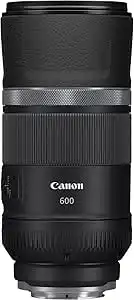
The Canon RF 600mm f/11 IS STM stands as a remarkable and somewhat unconventional entry into the super-telephoto segment for Canon's full-frame mirrorless RF system. Departing significantly from traditional high-cost, fast-aperture telephoto primes, this lens is engineered with a distinct philosophy: to make extreme reach accessible and portable. Its design prioritizes compactness and affordability, achieved through a fixed f/11 aperture and an innovative retractable barrel mechanism, delivering a 600mm focal length in a package that belies its capabilities.
From a physical perspective, the RF 600mm f/11 IS STM is astonishingly lightweight for a lens of its focal length, tipping the scales at just 930 grams. This puts it squarely in the weight class of much shorter zoom lenses, not dedicated super-telephotos. Its compact design is further enhanced by a retractable barrel that requires extension before use, shrinking its dimensions for storage and transport. While this adds a small step to setup, it's a worthwhile trade-off for the reduced footprint. The build quality, primarily utilizing high-grade engineering plastics, feels robust enough for its intended use, though it naturally doesn't possess the premium feel of Canon's L-series lenses. A substantial 82mm filter thread allows for the use of common filters, a practical inclusion given its specific use cases.
The optical core of this lens is its fixed 600mm focal length and, most notably, its fixed f/11 maximum (and only) aperture. This design choice is the primary enabler of its compact size and accessible price point. The optical formula consists of 10 elements in 7 groups, including Diffractive Optics (DO) which contribute significantly to the lens's size and weight reduction while maintaining image quality. In terms of sharpness, the RF 600mm f/11 IS STM generally delivers good results, particularly in the center of the frame, especially when shooting in bright, well-lit conditions. Images exhibit a level of detail suitable for prints and high-resolution displays, especially when paired with modern high-megapixel RF cameras. Edge performance, while not as critically sharp as the center, remains acceptable for a lens of this class. Chromatic aberrations are typically well-controlled, with in-camera corrections further refining the output. The fixed f/11 aperture means there are no physical diaphragm blades, leading to a smooth, if not overtly dramatic, rendition of out-of-focus areas. While f/11 doesn't offer the shallow depth of field associated with faster telephotos, the immense 600mm focal length still provides a decent degree of subject separation from backgrounds, especially at closer focusing distances.
Autofocus is handled by Canon's STM (Stepping Motor) system. This motor is known for its quiet and smooth operation, making it suitable for both still photography and video recording. In practice, the STM autofocus performs commendably in good lighting conditions, locking onto subjects with reasonable speed and accuracy. For static or predictably moving subjects, it proves to be quite reliable. However, the fixed f/11 aperture inherently presents challenges for autofocus systems, particularly in lower light environments where the camera's AF sensors receive less light. This can lead to slower acquisition speeds or increased hunting, and some AF points may be deactivated on certain camera bodies. It's a trade-off that users must be aware of, aligning with the lens's intended use in brighter conditions.
Crucial to the usability of any long telephoto lens, especially one with a relatively slow aperture, is image stabilization. The RF 600mm f/11 IS STM incorporates effective built-in optical image stabilization, rated by Canon at approximately 5 stops of correction. This system is highly beneficial, helping to mitigate camera shake and allowing for sharper images at slower shutter speeds than would otherwise be possible. It's an indispensable feature for hand-holding a 600mm lens, vastly improving the practical success rate of shots, particularly in situations where a tripod isn't feasible or desired.
The RF 600mm f/11 IS STM excels in several specific use cases:
- Wildlife and Bird Photography: This is arguably its primary domain. The 600mm reach is ideal for filling the frame with distant animals or birds without disturbing them. Its lightweight and compact nature make it an excellent choice for photographers who need to hike or carry their gear for extended periods. The fixed f/11 aperture necessitates shooting in bright daylight or pushing ISO in overcast conditions, but for well-lit scenarios, it offers an accessible entry point into serious telephoto wildlife work.
- Sports Photography (Daylight): For outdoor sports played under ample sunlight, the 600mm f/11 can capture distant action effectively. It's particularly suited for sports with predictable movements, where the STM autofocus can keep pace. While it won't rival the low-light performance or rapid-fire AF of professional f/4 or f/2.8 super-telephotos, it provides excellent reach for daytime events like track and field, soccer, or even air shows.
- Astro-landscape and Celestial Photography: While f/11 is too slow for wide-field deep-sky astrophotography, this lens can be surprisingly effective for specific celestial subjects, most notably moon photography. Its 600mm focal length allows for capturing impressive detail of the moon's surface. For distant elements in astro-landscape scenes under bright moonlight, it could also find a niche. However, for general night sky or Milky Way photography, its f/11 aperture is a significant limitation due to insufficient light gathering.
In conclusion, the Canon RF 600mm f/11 IS STM is a highly specialized lens that carves out a unique niche within the RF ecosystem. It's not a lens for everyone, nor is it designed to compete with the flagship L-series super-telephotos. Instead, it offers an unprecedented combination of extreme focal length, portability, and affordability. For photographers who primarily shoot in good light and prioritize reach and ease of transport over aperture flexibility and ultimate low-light performance, this lens represents a compelling and genuinely innovative option. It democratizes super-telephoto photography, making 600mm accessible to a broader range of enthusiasts and professionals who might otherwise be priced out of such focal lengths. Its success hinges on understanding and embracing its inherent design compromises, particularly the fixed f/11 aperture, to unlock its considerable potential in its ideal photographic environments.