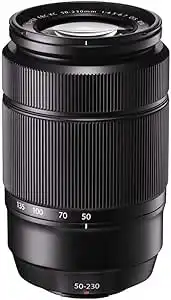
The Fujifilm XC 50-230mm f/4.5-6.7 OIS II is a telephoto zoom lens that occupies a crucial and highly popular space within the X-mount ecosystem. Designed as a companion to the standard kit lenses, it provides photographers with significant telephoto reach in a remarkably lightweight and affordable package. While Fujifilm's premium XF lens series is renowned for its exceptional build and optical quality, the XC line prioritizes accessibility and portability. This lens is a prime example of that philosophy, offering a compelling balance of performance and practicality for aspiring photographers and seasoned enthusiasts alike.
Upon first handling the lens, its most striking characteristic is its weight. At a mere 375 grams, it is exceptionally light for a lens offering a 35mm equivalent focal range of 76-350mm. This makes it an ideal travel companion, easily fitting into a small camera bag without adding significant bulk. The construction is predominantly high-quality plastic, from the barrel to the mount. While this may lack the premium, cold-to-the-touch feel of its metal-clad XF counterparts, the build feels solid and well-assembled, with no discernible creaks or rattles. The zoom and focus rings are broad and operate smoothly, though they lack the refined dampening of higher-end optics. In line with its XC designation, the lens omits an external aperture ring, with f-stop adjustments being handled through the camera body's command dials.
Optically, the XC 50-230mm f/4.5-6.7 delivers performance that often surpasses expectations for its price point. The most significant compromise is its variable and relatively slow maximum aperture, which ranges from f/4.5 at the 50mm end to a modest f/6.7 when fully extended to 230mm. This makes the lens best suited for use in bright, daylight conditions. In lower light, photographers will need to rely on higher ISO settings or slower shutter speeds to achieve proper exposure, which is where the lens's other key feature comes into play.
The built-in Optical Image Stabilization (OIS) is highly effective and arguably essential for a lens with this focal range and aperture. Fujifilm claims up to 3.5 stops of compensation, and in practice, this system performs admirably. It allows for sharp handheld shots at shutter speeds significantly slower than would otherwise be possible, helping to mitigate the limitations of the slow aperture in static scenes and making the lens far more versatile than its specifications might suggest.
In terms of image quality, center sharpness is very good across the majority of the zoom range, particularly when stopped down to f/8 or f/11. Images are detailed and crisp, capable of resolving fine textures on distant subjects. As is common with consumer-grade zoom lenses, corner performance is softer, especially at the widest and longest focal lengths with the aperture wide open. However, for many of the lens's intended applications, such as wildlife or sports where the subject is typically centered, this is a minor issue. Chromatic aberration is well-controlled, and Fujifilm's excellent in-camera lens corrections effectively eliminate most concerns about distortion and vignetting in JPEG files.
Autofocus is driven by a stepping motor, which provides smooth and nearly silent operation, a benefit for videographers or those needing discretion. For still photography of static or moderately moving subjects, the autofocus is confident and accurate. However, when tasked with tracking fast, erratically moving subjects—such as birds in flight or high-speed sports—the lens can struggle to keep pace compared to more advanced and expensive telephoto options. It is perfectly capable for casual sports and wildlife photography, but professionals will likely require the faster performance of Fujifilm's XF telephoto zooms.
The true strength of the XC 50-230mm lies in the use cases it unlocks for the budget-conscious photographer. For outdoor and travel photography, its combination of an expansive zoom range and low weight is a winning formula. It allows photographers to capture distant landscapes, architectural details, and candid street scenes without the burden of a heavy kit. It serves as an excellent entry point into wildlife photography, perfect for daytime trips to a zoo or a local nature reserve where animals are at a comfortable distance. Similarly, it is well-suited for capturing daytime field sports from the sidelines, bringing the action closer without a significant financial investment. While not a dedicated portrait lens, at the longer end of its zoom it can produce pleasing subject compression and, with sufficient distance between the subject and background, a reasonably soft, blurred backdrop.
In conclusion, the Fujifilm XC 50-230mm f/4.5-6.7 OIS II is a lens defined by intelligent compromises. It trades a fast aperture and metal construction for incredible portability and affordability. While it may not possess the outright optical perfection or lightning-fast autofocus of its professional-grade siblings, it delivers impressive image quality, a highly versatile focal range, and effective image stabilization. For Fujifilm shooters looking to explore the world of telephoto photography without breaking the bank or their back, this lens represents outstanding value and is a highly recommended addition to their kit.