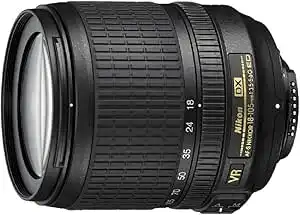
The Nikon AF-S DX Nikkor 18-105mm f/3.5-5.6G ED VR is a popular and versatile zoom lens designed specifically for Nikon's DX-format (APS-C) DSLR cameras. Often bundled as a kit lens with mid-range bodies, it aims to provide a comprehensive focal range that caters to a vast array of photographic scenarios, making it a compelling choice for photographers seeking an all-in-one solution without significant investment.
Design and Build Quality Weighing in at a modest 420 grams, the 18-105mm VR lens strikes a good balance between portability and functionality. Its compact design is a notable advantage, especially for travel and everyday use where minimizing bulk is desirable. The construction primarily utilizes high-quality plastics, which contribute to its light weight. While robust enough for general use, some photographers might prefer the more premium feel and potential long-term durability of lenses featuring a metal mount. However, for its target market and price point, the build is entirely acceptable. The lens accommodates a common 67mm filter thread, making it easy to share filters with other lenses in a photographer's kit.
Focal Length and Versatility The standout feature of the 18-105mm VR is its incredibly flexible focal range. On a DX-format camera, the 18mm wide-angle end translates to an equivalent field of view of approximately 27mm on a full-frame sensor, providing ample breadth for expansive landscapes, architectural shots, and large group photos. Zooming in to 105mm offers an equivalent of about 157.5mm, extending into the telephoto territory, which is highly beneficial for isolating subjects, capturing portraits with pleasing compression, or bringing distant elements closer. This broad range significantly reduces the need to frequently swap lenses, enhancing the shooting experience and making it exceptionally suitable for a wide variety of subjects.
Optical Performance Nikon has incorporated several advanced optical elements to enhance image quality. The lens features ED (Extra-low Dispersion) glass elements, designed to minimize chromatic aberrations, and Aspherical elements, which help to control spherical aberration and distortion.
- Sharpness: In terms of sharpness, the lens performs admirably for a superzoom of its class. Centrally, it delivers good to very good sharpness throughout its focal range, especially when stopped down slightly from its maximum aperture. As with many variable-aperture zooms, sharpness tends to soften towards the edges and corners, particularly at the widest apertures and focal lengths. Stopping down to f/8 or f/11 generally yields the best overall sharpness across the frame.
- Distortion and Vignetting: Distortion is present, as expected from such a wide zoom range. At 18mm, barrel distortion is noticeable, while pincushion distortion can be observed at the longer end. Both are relatively straightforward to correct in post-processing software. Vignetting (darkening of the corners) is also evident at wider apertures and focal lengths but typically becomes less pronounced when stopped down.
- Flare and Chromatic Aberration: Thanks to Nikon's optical design, flare is generally well-controlled, though direct sun can still produce some ghosting. Chromatic aberrations are present but are typically mild and manageable.
- Bokeh: The lens features 7 rounded diaphragm blades, which contribute to a reasonably pleasing out-of-focus background (bokeh). While the variable maximum aperture of f/3.5-5.6 means it won't produce the shallow depth of field of a fast prime lens, at 105mm and f/5.6, it can still achieve a decent subject-background separation, particularly when the subject is relatively close to the lens and the background is distant.
Autofocus and Vibration Reduction (VR) The integration of Nikon's Silent Wave Motor (SWM) ensures swift, accurate, and notably quiet autofocus. This is a significant advantage for video recording or in situations where discretion is required, such as street photography or events. The autofocus system generally locks onto subjects quickly and reliably in various lighting conditions. Perhaps one of the most crucial features for a versatile zoom lens is Vibration Reduction (VR). Nikon's VR system in this lens is highly effective, offering up to several stops of compensation. This allows photographers to handhold the camera at slower shutter speeds than would otherwise be possible, significantly reducing the risk of motion blur. This benefit is particularly valuable when shooting in low light, at longer focal lengths, or when maximum sharpness is desired without a tripod.
Suitable Use Cases The Nikon 18-105mm f/3.5-5.6G ED VR truly excels as an Everyday Photography companion, serving as an ideal single-lens solution for general shooting. Its broad focal range, coupled with VR, makes it highly effective for Travel photography, allowing photographers to capture everything from sweeping landscapes to close-ups of distant landmarks without carrying multiple heavy lenses. For Landscape photography, the 18mm wide end is very useful, and the sharpness when stopped down makes it a capable performer. While not a dedicated portrait lens, the 105mm end offers a flattering perspective and decent background separation for Portraits, especially environmental portraits. Its quiet autofocus, compact size, and versatile reach also make it a strong contender for Street Photography, enabling photographers to adapt quickly to diverse scenes.
Conclusion The Nikon AF-S DX Nikkor 18-105mm f/3.5-5.6G ED VR represents a compelling package for DX-format Nikon DSLR users. It delivers an outstanding balance of versatility, convenience, and performance for its price point. While it exhibits some optical compromises inherent in its superzoom design, such as variable aperture and some distortion, these are generally minor and often correctable. Its effective Vibration Reduction and fast, quiet autofocus system significantly enhance its usability. For those seeking a single, highly adaptable lens for a wide range of photographic pursuits—from travel and landscapes to portraits and street photography—this lens stands out as a reliable and high-value option, offering an excellent starting point or an indispensable everyday companion for the Nikon DX system.