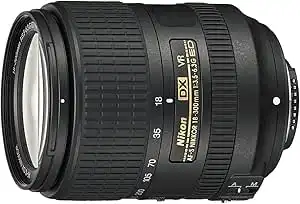
The Nikon AF-S DX NIKKOR 18-300mm f/3.5-6.3G ED VR stands as a compelling option for Nikon DX-format DSLR users seeking a single, highly versatile lens. Designed specifically for the F-mount, this superzoom aims to be the ultimate all-in-one solution, offering an extraordinary 16.7x zoom ratio that spans from a wide-angle 18mm to a super-telephoto 300mm. Its core appeal lies in eliminating the need to frequently swap lenses, making it particularly attractive to photographers who value convenience and portability without wanting to compromise too much on focal range.
From a technical standpoint, the lens encompasses an impressive range, starting at a useful 18mm, equivalent to approximately 27mm on a full-frame camera, which is ideal for capturing expansive landscapes, architectural interiors, or group shots. The zoom extends all the way to 300mm, providing an effective focal length of around 450mm on a DX body. This telephoto reach allows for isolating distant subjects, whether for casual wildlife observation, sports events from the sidelines, or tight portraiture. This vast range inherently positions the lens as a strong contender for "all-in-one" and "travel photography" categories, where minimizing gear weight and avoiding missed shots due to lens changes are paramount.
The aperture of the 18-300mm is a variable f/3.5-6.3, a common characteristic among superzoom lenses of this type. While f/3.5 at the wide end is reasonably bright, the aperture narrows considerably to f/6.3 by the time the lens reaches its telephoto extreme. This means that in low-light conditions, or when attempting to achieve significant background blur at longer focal lengths, photographers will need to compensate with higher ISO settings or slower shutter speeds. The minimum aperture ranges from f/22 to f/40, providing ample depth of field for landscapes or achieving longer exposures in bright light. The seven-blade diaphragm aims to produce pleasing out-of-focus areas, though the relatively slow maximum aperture will inherently limit its bokeh-rendering capabilities compared to lenses with wider, fixed apertures.
A critical feature enhancing the lens's usability, especially at its longer focal lengths, is Nikon's Vibration Reduction (VR) system. With the ability to minimize camera shake, VR significantly improves the chances of capturing sharp images when shooting handheld, particularly in dimmer lighting conditions or when using the 300mm end of the zoom. This is a crucial addition for a lens spanning such a vast range, enabling photographers to shoot at slower shutter speeds than would otherwise be possible, thereby retaining lower ISO values and better image quality.
Autofocus is handled by Nikon's Silent Wave Motor (SWM), ensuring swift, quiet, and precise focusing performance. This is beneficial for both stills photography and video recording, as the minimal motor noise helps prevent audio interference. The SWM allows for seamless switching between auto and manual focus, giving photographers immediate override capabilities when desired. Coupled with a minimum focus distance of 0.48 meters (1.58 feet) and a maximum magnification ratio of 0.29x, the lens offers respectable close-up capabilities for capturing details, though it is not a dedicated macro lens.
Optically, the 18-300mm f/3.5-6.3G ED VR incorporates advanced elements to maintain image quality across its extensive zoom range. It features Extra-low Dispersion (ED) glass elements, which are crucial for minimizing chromatic aberrations and delivering superior contrast and color fidelity. Aspherical elements are also employed to correct spherical aberrations and distortion, contributing to a more compact design while maintaining sharpness. The lens construction comprises 16 elements in 12 groups. While superzooms inherently involve optical compromises compared to prime lenses or more specialized zooms, the inclusion of these advanced elements indicates an effort to mitigate common issues such as distortion, vignetting, and sharpness fall-off, especially at the extreme ends of the zoom.
Weighing in at a modest 550 grams (19.4 ounces) and accepting a common 67mm filter thread, the lens maintains a relatively compact and manageable profile, reinforcing its suitability as a travel and everyday lens. Its lightweight construction is a significant advantage for photographers who carry their gear for extended periods or want to minimize bulk in their camera bag.
Use Cases Where This Lens Excels:
- Travel Photography: This is arguably the lens's strongest suit. The vast 18-300mm range covers nearly every scenario a traveler might encounter, from wide-angle street scenes and grand landscapes to telephoto shots of distant landmarks or wildlife. The VR system and compact design further enhance its travel readiness.
- All-in-one Lens / Everyday Photography: For photographers who prefer to carry just one lens, this NIKKOR is an ideal solution. It handles a wide variety of daily shooting situations without requiring lens changes, from family events and casual outings to street photography.
- Casual Wildlife Photography: While not a fast, professional-grade wildlife lens, the 300mm reach provides ample magnification for capturing animals from a distance. For amateur enthusiasts or those on safari who prioritize versatility over absolute speed or low-light performance, it's a practical choice.
- Landscape Photography: The 18mm wide end is well-suited for sweeping landscapes. While dedicated landscape lenses might offer superior edge-to-edge sharpness or wider apertures for low-light scenes, the 18-300mm provides a convenient option for capturing broad vistas without switching lenses.
Considerations:
While highly versatile, it's important to set realistic expectations for a superzoom. The variable aperture can be a limitation in challenging low-light conditions, and optical performance, particularly sharpness and distortion, may not match that of high-end prime lenses or professional-grade zooms at their respective focal lengths. However, for photographers who prioritize convenience, versatility, and a light setup, these trade-offs are often acceptable.
In conclusion, the Nikon AF-S DX NIKKOR 18-300mm f/3.5-6.3G ED VR is an intelligently designed lens for Nikon DX DSLR users seeking a truly multi-purpose optic. Its expansive focal range, effective Vibration Reduction, and reliable autofocus make it an excellent choice for travel, everyday shooting, and general photography where the ability to capture a diverse range of subjects without changing lenses is paramount. It delivers a commendable balance of performance and convenience, making it a highly practical companion for photographers who value versatility above all else.