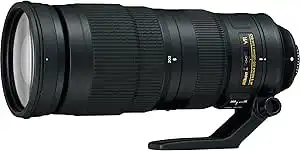
Nikon AF-S NIKKOR 200-500mm f/5.6E ED VR Lens Review
The Nikon AF-S NIKKOR 200-500mm f/5.6E ED VR is a super-telephoto zoom lens designed for Nikon F-mount DSLR cameras, compatible with both FX (full-frame) and DX (APS-C) formats. Since its introduction, it has garnered significant attention as a versatile and relatively accessible option for photographers requiring substantial reach without the prohibitive cost often associated with professional telephoto primes. This review delves into its capabilities, performance, and the specific use cases where it truly shines, maintaining an objective and balanced perspective.
Optical Design and Key Features
At its core, the 200-500mm f/5.6E ED VR boasts an impressive focal range, offering an extensive view from medium telephoto to extreme super-telephoto. This versatility eliminates the need to swap lenses frequently when tracking subjects that may vary in distance. A standout feature is its constant f/5.6 maximum aperture across the entire zoom range. This allows for consistent exposure settings, a significant advantage when shooting in variable light or using manual exposure modes, ensuring predictable results from 200mm all the way to 500mm. While not an ultra-fast aperture like f/2.8 or f/4 lenses, f/5.6 is commendable for such a broad zoom range and helps keep the lens's size and weight more manageable.
Optically, the lens is constructed with 19 elements in 12 groups, incorporating Extra-low Dispersion (ED) glass elements. The inclusion of ED glass is critical for minimizing chromatic aberrations, which often manifest as color fringing around high-contrast edges. This design choice contributes to sharper images with improved contrast and more accurate color rendition, particularly at longer focal lengths where such aberrations can be more pronounced. The lens features a 9-blade electromagnetic diaphragm (E-type), which provides smooth and pleasing bokeh, allowing for effective subject isolation when shooting at wider apertures. The E-type diaphragm also ensures precise and consistent aperture control, especially beneficial during high-speed continuous shooting sequences.
Performance in the Field
A major highlight of this lens is its highly effective Vibration Reduction (VR) system, which Nikon claims offers up to 4.5 stops of compensation. This is crucial for a lens of this focal length, enabling photographers to hand-hold the camera at slower shutter speeds than would otherwise be possible, significantly reducing the risk of camera shake blur. The VR system includes a specialized Sport Mode, designed specifically for tracking fast-moving subjects. In Sport Mode, the VR stabilizes the viewfinder image without hindering panning movements, making it easier to follow erratic motion and capture sharp images of subjects in action. This feature alone makes the lens exceptionally well-suited for dynamic photography genres.
Autofocus is driven by Nikon's Silent Wave Motor (SWM), which delivers fast, quiet, and accurate focusing performance. The speed and precision of the SWM are vital for subjects that move unpredictably, ensuring critical focus is achieved and maintained. While generally robust, AF performance can depend on the camera body's capabilities, especially in very low light conditions where an f/5.6 aperture might require the camera's AF system to work harder compared to faster prime lenses. The lens has a minimum focus distance of 2.2 meters (7.2 feet) and offers a maximum magnification of 0.22x, providing some utility for closer subjects, though it is not a macro lens.
Build Quality and Handling
Weighing in at 2300 grams (approximately 5.1 lbs), the AF-S NIKKOR 200-500mm f/5.6E ED VR is a substantial piece of glass. While it can be hand-held for short periods, for extended shooting sessions or maximum stability, a monopod or tripod is highly recommended. The lens includes a rotatable tripod collar, which is essential for balancing the camera and lens assembly on support systems and for quickly switching between horizontal and vertical orientations without re-positioning the entire setup. The build quality is robust, typical of Nikon's professional-grade optics, designed to withstand the rigors of outdoor photography. The front element accommodates large 95mm filters, which, while providing excellent light gathering, means replacement filters can be expensive.
Ideal Use Cases
The Nikon 200-500mm f/5.6E ED VR truly excels in several demanding photographic disciplines:
- Wildlife Photography: The extensive 200-500mm range provides the necessary reach to capture shy or distant animals without disturbing them. The constant f/5.6 aperture, combined with the effective VR (including Sport Mode), makes it a formidable tool for tracking wildlife, whether in flight or on the ground, even in challenging lighting conditions.
- Sports Photography: For field sports, track events, or motorsports, the long focal length allows photographers to isolate action from afar. The fast SWM autofocus and Sport Mode VR are invaluable for freezing peak action and maintaining sharp focus on fast-moving athletes or vehicles.
- Aviation Photography: From airshows to planespotting, the 500mm end allows for spectacular close-up shots of aircraft. The VR system is crucial for stable handheld shots, especially when panning to follow planes as they move across the sky.
- Telephoto Landscape Photography: Beyond action, this lens is also an excellent choice for telephoto landscapes. It allows photographers to compress perspective, isolate distant geological features, and create dramatic compositions that emphasize patterns and details in the environment. The VR further aids in achieving sharp images of distant scenes, even when a tripod isn't practical.
Considerations and Conclusion
While a highly capable lens, it's important to acknowledge a few considerations. Its 2.3kg weight, while reasonable for its focal length, makes it heavy for prolonged hand-holding. The f/5.6 maximum aperture, while constant, is not as 'fast' as f/2.8 or f/4 telephoto primes, meaning it will necessitate higher ISOs or slower shutter speeds in very dim light, and may offer slightly less background separation. Lastly, the 95mm filter thread size means purchasing filters will be a more significant investment.
In conclusion, the Nikon AF-S NIKKOR 200-500mm f/5.6E ED VR represents an outstanding blend of reach, performance, and value for Nikon F-mount DSLR users. It offers excellent image quality, reliable autofocus, and a highly effective VR system, particularly the specialized Sport Mode. For enthusiasts and professionals seeking a dedicated super-telephoto zoom lens that excels in wildlife, sports, aviation, and telephoto landscape photography, this lens delivers a compelling package, making it a highly recommended addition to a telephoto arsenal.