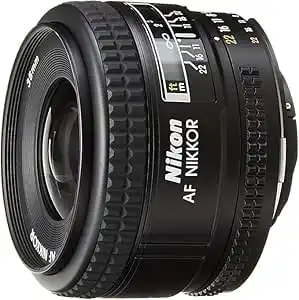
The Nikon AF NIKKOR 35mm f/2D is a compact and lightweight full-frame prime lens, designed for Nikon F-mount DSLR systems. Positioned as a versatile everyday companion, this lens boasts a classic 35mm focal length combined with a bright f/2 maximum aperture, making it a compelling option for a range of photographic disciplines. Its "D" type designation indicates its ability to relay distance information to the camera body, which is particularly beneficial for accurate flash metering.
Build Quality and Ergonomics Weighing a mere 205 grams, the AF NIKKOR 35mm f/2D is exceptionally light, making it an ideal choice for photographers seeking to minimize their kit's burden. Its compact dimensions further contribute to its portability, allowing it to fit comfortably in smaller camera bags or even a coat pocket. The lens features a robust, though predominantly plastic, construction that feels solid enough for daily use without adding unnecessary bulk. The 52mm filter thread is a common size, making filter acquisition and sharing among lenses convenient and economical. The aperture ring is a notable feature, providing tactile control for users who prefer manual aperture selection, especially when used with older film cameras or specific digital bodies that support this functionality. The focus ring operates smoothly, exhibiting good damping, which is beneficial for precise manual focusing. The rear focusing mechanism is a design advantage, as the front element does not rotate or extend during focusing, which is useful when using polarizing or graduated neutral density filters.
Optical Performance The optical formula of the AF NIKKOR 35mm f/2D consists of 6 elements in 5 groups, a relatively simple design compared to modern, more complex optics. Despite its age, this configuration delivers commendable image quality, especially when stopped down slightly.
- Sharpness: At its maximum aperture of f/2, the lens provides good central sharpness, which is more than adequate for many applications. As with many older prime lenses, corner sharpness tends to lag behind the center, particularly wide open on a full-frame sensor. Stopping down to f/2.8 or f/4 significantly improves sharpness across the frame, bringing the corners much closer in performance to the center. Peak sharpness is typically achieved around f/5.6 to f/8.
- Aperture and Bokeh: The f/2 maximum aperture is a significant asset, allowing for effective subject isolation and attractive background blur (bokeh). The lens employs a 7-blade diaphragm, which produces reasonably smooth out-of-focus areas, though highlights can sometimes exhibit a hexagonal shape when stopped down significantly. The bright aperture is also invaluable for shooting in challenging low-light conditions without excessively raising ISO.
- Chromatic Aberrations: Lateral chromatic aberrations (color fringing) can be present, particularly in high-contrast scenes at wider apertures. These are often manageable with in-camera corrections on newer DSLRs or through post-processing software. Longitudinal chromatic aberrations (LoCA) may also appear, manifesting as magenta or green fringing in front of or behind the plane of focus.
- Distortion and Vignetting: A modest amount of barrel distortion is typical for a 35mm lens of this design, and it is usually easily correctable in post-production. Vignetting is noticeable at f/2 on full-frame cameras, darkening the corners of the frame. This effect diminishes rapidly upon stopping down and is largely gone by f/4. For some photographic styles, this natural fall-off can even be an aesthetically pleasing characteristic.
- Flare: While not featuring Nikon's more advanced coatings found in modern lenses, the AF NIKKOR 35mm f/2D generally handles flare reasonably well. Direct sunlight or strong artificial light sources may introduce some ghosting or a reduction in contrast, but it is typically not overly intrusive.
Autofocus Performance As a "D" type lens, the AF NIKKOR 35mm f/2D relies on a screw-drive motor in compatible Nikon DSLR bodies for autofocus. This means that entry-level DSLRs without an in-body motor (e.g., D3000/D5000 series) will only be able to use this lens with manual focus. When paired with a compatible body, autofocus is generally quick and accurate enough for most static or moderately moving subjects. However, it is important to note that the screw-drive mechanism can be audibly noisy compared to modern AF-S or mirrorless lens motors. For video recording, this noise can be a significant drawback. The rear focusing design contributes to faster AF by moving lighter elements, enhancing the overall focusing experience. The minimum focus distance of 0.25 meters allows for reasonably close-up shots, though the maximum magnification of 0.14x indicates it is not a macro lens.
Use Cases The combination of its versatile focal length, bright aperture, and compact form factor makes the AF NIKKOR 35mm f/2D excel in several key photographic genres:
- Street Photography: The 35mm focal length is a classic for street photographers, offering a natural perspective that allows subjects to be captured within their environment without being overly wide or telephoto. Its compact size and inconspicuous nature make it less intimidating, aiding in candid captures.
- Travel Photography: Lightweight and versatile, this lens is an excellent travel companion. It can handle landscapes, environmental portraits, and general documentary-style shots, reducing the need to carry multiple lenses.
- Environmental Portraits: The f/2 aperture provides enough background separation to isolate subjects, while the 35mm perspective allows for inclusion of the surroundings, providing context to the portrait.
- Low Light Photography: The f/2 maximum aperture is crucial for shooting in dimly lit conditions, enabling faster shutter speeds or lower ISOs, thereby reducing motion blur and noise.
- Everyday Use: Its balanced characteristics—compact, lightweight, and versatile focal length—make it an ideal "walk-around" lens for capturing daily life, from family gatherings to casual outings.
Conclusion The Nikon AF NIKKOR 35mm f/2D remains a relevant and valuable lens, particularly for Nikon F-mount DSLR users seeking a lightweight, bright prime. While it lacks modern features like internal focus motors, silent autofocus, or optical image stabilization, its core strengths lie in its optical quality (especially when stopped down), compact form, and the timeless appeal of the 35mm focal length. For photographers working in street, travel, environmental portraiture, or simply needing a reliable everyday lens, and who are willing to embrace its classic screw-drive autofocus system (or manual focus), this lens offers an excellent balance of performance, portability, and value. It serves as a testament to Nikon's legacy of producing robust and capable optics that continue to perform well in the hands of discerning photographers.