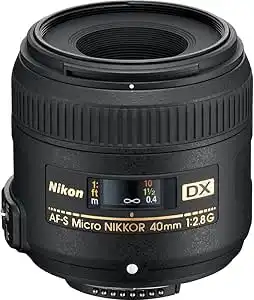
Nikon AF-S DX Micro-Nikkor 40mm f/2.8G Lens Review: A Versatile DX Macro Prime
The Nikon AF-S DX Micro-Nikkor 40mm f/2.8G stands out as a unique and compelling offering within Nikon's F-mount (DSLR) ecosystem, specifically designed for its DX (APS-C) format cameras. Positioned as a compact, lightweight prime lens, its dual identity as a true 1:1 macro optic and a versatile everyday prime makes it an intriguing option for a wide array of photographers. This review delves into its capabilities, performance, and the use cases where it truly excels, maintaining an objective and balanced perspective.
At its core, the 40mm f/2.8G is a DX-format lens, meaning it's optimized for Nikon's APS-C sensor DSLRs. On such a body, its 40mm focal length translates to an angle of view roughly equivalent to a 60mm lens on a full-frame camera. This equivalent focal length immediately hints at its versatility, positioning it squarely in classic territory for portraits, street photography, and general-purpose shooting while also serving its primary function as a macro lens.
One of the lens's most defining characteristics is its macro capability, offering a true 1:1 (life-size) magnification. This means that subjects can be reproduced on the camera sensor at the same size they appear in reality, enabling the capture of intricate details often invisible to the naked eye. To achieve this impressive magnification, the lens boasts a minimum focus distance of just 0.163 meters (approximately 6.4 inches). While this close focusing distance is essential for 1:1 macro, it also implies a relatively short working distance between the front element of the lens and the subject. For very shy insects or subjects in tight spaces, a longer macro lens might offer more flexibility. However, for static subjects like flowers, coins, stamps, or small products, this working distance is perfectly manageable and can even aid stability.
Optically, the lens is constructed with 9 elements in 7 groups, a design aimed at delivering sharp images across the frame. Its maximum aperture of f/2.8 provides a good balance between light gathering ability and size. While not as fast as some f/1.8 or f/1.4 primes, f/2.8 is more than adequate for most shooting conditions, especially when coupled with the excellent high ISO performance of modern DX bodies. The relatively wide aperture also allows for pleasing subject separation and smooth background blur (bokeh), further enhanced by its 7-bladed rounded diaphragm. Stopped down to its minimum aperture of f/22, the lens provides extensive depth of field, which is often crucial in macro photography where razor-thin focus planes are common.
Autofocus performance is handled by Nikon's Silent Wave Motor (SWM), an internal focusing system that ensures quiet, swift, and accurate operation. This is particularly beneficial for video recording where focus motor noise can be disruptive, and for discreet shooting situations like street photography. The SWM also allows for full-time manual focus override, enabling photographers to fine-tune focus without switching out of autofocus mode – a highly practical feature, especially in macro work where precision is paramount. It's worth noting the absence of optical image stabilization (VR) in this lens. While not uncommon for primes, especially at shorter focal lengths, its omission means photographers will need to rely on faster shutter speeds or a tripod to mitigate camera shake, particularly when shooting handheld macro or in low light.
In terms of physical attributes, the AF-S DX Micro-Nikkor 40mm f/2.8G is commendably compact and lightweight, tipping the scales at just 235 grams. This makes it an ideal companion for smaller DX bodies, balancing well and contributing to a comfortable, portable setup. Its 52mm filter thread is a common size, making it easy to share filters with other lenses. The robust, yet lightweight build quality typical of Nikon's G-series lenses inspires confidence without adding unnecessary bulk.
Given its specifications, this lens excels in several specific photographic genres:
- Macro Photography: This is its primary calling. The 1:1 magnification, sharp optics, and close minimum focus distance make it superb for capturing the intricate details of flowers, insects, water droplets, and other small subjects.
- Product Photography: Its ability to render sharp details and provide life-size magnification is invaluable for small product photography, ideal for e-commerce listings or artistic close-ups.
- Portraits (APS-C): The 60mm equivalent focal length on DX is a classic choice for portraits, offering a natural perspective without significant distortion. The f/2.8 aperture allows for good background separation, making subjects stand out.
- Everyday Photography & Street Photography: Its compact size, light weight, and versatile focal length (60mm equivalent) make it an excellent "walk-around" lens. It's unobtrusive and capable of capturing a wide variety of scenes from environmental portraits to detailed street scenes.
While the lens offers a compelling package, it's important to consider its limitations. The shorter working distance for macro can be challenging for skittish subjects or when lighting is complex, potentially requiring external flashes or ring lights to avoid casting shadows. The lack of VR also means handheld macro requires careful technique, often necessitating a tripod for optimal results. For those accustomed to faster f/1.8 or f/1.4 primes, the f/2.8 maximum aperture might feel limiting in extremely low light, though its performance remains strong.
In conclusion, the Nikon AF-S DX Micro-Nikkor 40mm f/2.8G is a highly capable and versatile lens for Nikon DX DSLR users. It successfully bridges the gap between a dedicated macro lens and a general-purpose prime, offering excellent image quality, true 1:1 magnification, and a comfortable equivalent focal length for a variety of photographic pursuits. Its compact size, light weight, and silent autofocus make it a practical choice for everyday carry. While its shorter working distance for macro and absence of VR are factors to consider, these are minor trade-offs for a lens that delivers exceptional performance and value, making it a highly recommended addition to any DX photographer's kit.