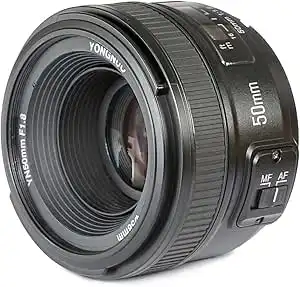
Nikon AF-S NIKKOR 50mm f/1.8G Review: A Versatile and Accessible Prime
The Nikon AF-S NIKKOR 50mm f/1.8G holds a revered position in many photographers' kits, particularly those utilizing Nikon's F-mount DSLR systems. Often dubbed the "nifty fifty," this full-frame (FX-format) prime lens is celebrated for its blend of optical performance, compact design, and exceptional value. It caters to a wide array of photographic disciplines, from intimate portraits to dynamic street scenes and challenging low-light environments, making it a compelling choice for both enthusiasts and professionals seeking a high-performing yet affordable optic.
Design and Build Quality
Weighing a mere 185 grams, the AF-S NIKKOR 50mm f/1.8G is remarkably lightweight and compact, making it an ideal everyday lens that adds minimal bulk to a camera setup. Its construction is primarily of high-quality plastics, which contributes to its light weight while maintaining a reassuringly solid feel. The lens features a 58mm filter thread, a common size that makes accessory management straightforward. While not boasting the rugged, weather-sealed build of professional-grade lenses, its construction is entirely adequate for general photographic use and offers a pleasant tactile experience. The focus ring operates smoothly, providing precise manual focus control when needed, complementing its autofocus capabilities.
Optical Performance
Optically, the 50mm f/1.8G is a strong performer, especially considering its approachable price point. It comprises 7 elements in 6 groups, including one aspherical element designed to minimize spherical aberration and improve image quality across the frame.
- Sharpness: At its maximum aperture of f/1.8, the lens delivers good sharpness in the center of the frame, which improves noticeably as it's stopped down. By f/2.8 to f/4, sharpness across the frame is excellent, providing crisp detail suitable for discerning portraiture and landscape work alike. Corners, while softer at f/1.8, catch up quickly as the aperture is narrowed.
- Aperture and Bokeh: The fast f/1.8 maximum aperture is arguably one of the lens's most attractive features. It excels in low-light conditions, allowing for faster shutter speeds or lower ISO settings, thus preserving image quality. Furthermore, this wide aperture is instrumental in creating beautiful, shallow depth of field effects, isolating subjects against a smoothly blurred background. The 7 rounded diaphragm blades contribute significantly to this, rendering pleasingly circular out-of-focus highlights (bokeh) that are smooth and creamy, enhancing the artistic quality of images, particularly in portraits.
- Chromatic Aberration: Chromatic aberrations, both lateral and longitudinal, are generally well-controlled. While some minor fringing might be visible in high-contrast areas at wider apertures, it is typically minimal and easily correctable in post-processing.
- Distortion and Vignetting: Pincushion distortion is negligible, making the lens suitable for architectural or documentary work where straight lines are critical. Vignetting (darkening of corners) is present at f/1.8, as is common with fast primes, but it quickly diminishes by f/2.8 and is practically unnoticeable by f/4. Modern DSLRs often offer in-camera corrections for these phenomena, further mitigating their impact.
- Flare: Thanks to Nikon's Super Integrated Coating, the lens handles flare reasonably well. While direct strong light sources can induce some flare and ghosting, it's generally manageable and can even be used creatively.
Autofocus Performance
The integration of Nikon's Silent Wave Motor (SWM) is a significant advantage, particularly for newer DSLR bodies that lack an in-body focus motor. The SWM ensures fast, quiet, and accurate autofocus operation. The "Rear Focusing" mechanism means that the front element does not rotate during focusing, which is convenient for using polarizing or graduated neutral density filters. For stills photography, the autofocus speed is more than adequate for most situations, including tracking moderately moving subjects. The quiet operation is also a benefit for video recording, though dedicated video shooters might still prefer manual focus for critical adjustments. The minimum focus distance of 0.45 meters (1.5 feet) provides a maximum magnification of 0.15x, allowing for reasonably close-up shots, though it is not a macro lens.
Use Cases
The AF-S NIKKOR 50mm f/1.8G truly shines across several popular photographic genres:
- Portraits: Its 50mm focal length on a full-frame sensor provides a natural perspective, akin to human vision, making it ideal for flattering headshots, half-body portraits, and environmental portraits. The f/1.8 aperture allows for superb subject isolation and beautiful background blur, creating a professional look.
- Low Light Photography: The fast f/1.8 aperture is a game-changer in challenging lighting conditions. It enables photographers to capture images in dimly lit interiors or at night without resorting to excessively high ISOs, preserving detail and reducing noise.
- Street Photography: Its compact size, lightweight design, and natural field of view make it unobtrusive and perfect for capturing candid moments on the street. The quick autofocus and ability to shoot in diverse lighting further enhance its suitability.
- Everyday Photography: For general purpose shooting, the 50mm f/1.8G acts as an excellent standard prime. Its versatility and optical quality make it a fantastic choice for travel, events, or simply documenting daily life with superior image quality compared to many kit zooms.
Limitations and Considerations
While the lens offers tremendous value, it's important to acknowledge its limitations. It lacks built-in optical image stabilization (VR), which is typical for prime lenses of this focal length and price point. For photographers using bodies without in-body stabilization, this means relying on faster shutter speeds or a steady hand in low light. The maximum magnification of 0.15x, while useful, means it isn't designed for true macro photography. Additionally, while its build is solid, it doesn't offer the weather sealing and robustness of Nikon's professional f/1.4G or f/1.8 S-line Z-mount primes.
Conclusion
The Nikon AF-S NIKKOR 50mm f/1.8G stands as an indispensable tool for any Nikon F-mount DSLR user looking to elevate their photography without breaking the bank. Its combination of excellent optical performance, fast f/1.8 aperture, reliable autofocus, and lightweight design makes it incredibly versatile. Whether you're delving into portraiture, exploring street scenes, capturing moments in low light, or simply seeking a superior everyday lens, the "nifty fifty" delivers exceptional image quality and creative potential. It remains a benchmark for affordable prime lenses and an outstanding investment for photographers across various skill levels.