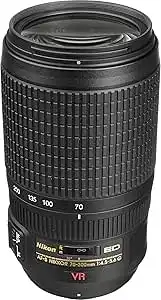
The Nikon AF-S VR Zoom-Nikkor 70-300mm f/4.5-5.6G IF-ED is a telephoto zoom lens designed for Nikon F-mount DSLR cameras, compatible with both DX and FX format sensors, though optimized for the latter. Positioned as a versatile and accessible option for enthusiasts, it offers a broad focal range that extends from medium telephoto to significant telephoto reach, making it a popular choice for those seeking an all-in-one solution for various photographic pursuits without investing in professional-grade, heavier, and more expensive alternatives.
At its core, this lens provides a focal length spanning from 70mm to 300mm. This range is particularly useful, starting at a classic portrait length on full-frame cameras and extending to a substantial telephoto, capable of bringing distant subjects much closer. The variable maximum aperture of f/4.5 at 70mm, gradually decreasing to f/5.6 at 300mm, is characteristic of consumer-oriented zoom lenses. While this can present limitations in very low light conditions or when striving for extreme background blur, it contributes significantly to the lens's manageable size and weight, making it a practical choice for everyday carry and travel.
A standout feature of this lens is Nikon's second-generation Vibration Reduction (VR II) technology. This optical image stabilization system is highly effective, allowing photographers to handhold the lens at significantly slower shutter speeds than would otherwise be possible. Nikon claims up to 3 stops of compensation, which is crucial for maintaining sharp images, especially when shooting at the longer end of the 300mm zoom range where camera shake is most pronounced. This makes the lens particularly well-suited for handheld outdoor photography, where tripods may be impractical or prohibited.
Autofocus performance is driven by Nikon's Silent Wave Motor (SWM), which delivers quiet, fast, and precise focusing. The SWM also enables full-time manual focus override, meaning users can fine-tune focus manually without needing to switch out of autofocus mode. The lens employs an Internal Focusing (IF) design, where only internal lens groups shift during focusing. This ensures the front element does not rotate, simplifying the use of polarizing or graduated neutral density filters, and maintains the lens's balance during operation.
Optically, the AF-S VR 70-300mm incorporates two Extra-low Dispersion (ED) glass elements. These specialized elements are crucial for minimizing chromatic aberration, a common optical flaw that manifests as color fringing around high-contrast edges. By effectively correcting for color dispersion, the ED glass contributes to sharper images with better color fidelity across the frame. The lens construction comprises 14 elements in 10 groups, and a 9-blade rounded diaphragm helps to render pleasing out-of-focus areas (bokeh), particularly when shooting at wider apertures and longer focal lengths. With a minimum focus distance of 1.5 meters and a maximum magnification of 0.24x, it offers decent, though not macro-level, close-up capabilities for smaller subjects.
Weighing approximately 745 grams, the lens strikes a good balance between portability and robust construction for its class. The 62mm filter thread is a common size, making filter acquisition relatively straightforward.
This lens truly excels in several specific use cases:
- Wildlife Photography: While not offering the extreme reach of dedicated super-telephoto primes, the 300mm focal length, combined with VR II, makes it a capable lens for capturing wildlife, especially larger animals or those that allow for closer approach. Its portability means it can be readily carried on hikes or safaris.
- Sports Photography: For outdoor sports during daylight hours, the 70-300mm range is highly versatile. It allows photographers to cover a significant portion of a field or court, capturing action from a distance. The SWM ensures quick subject tracking, and VR helps stabilize shots when panning or when subjects are relatively static.
- Event Photography: At larger events like concerts, conferences, or outdoor gatherings, this lens provides the necessary reach to capture candid moments or performers from a distance without intruding. The VR is invaluable for maintaining sharpness in dynamic environments.
- Travel Photography: For travelers who want a single telephoto lens that can cover a wide range of scenarios without adding excessive bulk or weight to their kit, this lens is an excellent choice. It’s adept at landscapes, cityscapes, architectural details, and even portraits from a distance, making it a highly adaptable travel companion.
- Portrait Photography: At the longer end of its focal range (e.g., 100mm-200mm), the lens can produce flattering compression and decent background separation for headshots and tighter portraits, especially when shot wide open. The 9-blade rounded diaphragm contributes to pleasant bokeh.
In terms of performance, users can generally expect good sharpness through much of the focal range, though, like many variable-aperture zooms, it may exhibit some softening at 300mm when shot wide open. Stopping down slightly often improves optical performance. Chromatic aberration is generally well-controlled thanks to the ED glass. Distortion and vignetting may be present at the extreme ends of the zoom, but these are often minor and easily correctable in post-processing. The autofocus is generally reliable and quick in good light, though its performance can vary with the specific DSLR body it's paired with.
In conclusion, the Nikon AF-S VR Zoom-Nikkor 70-300mm f/4.5-5.6G IF-ED is a highly capable and versatile telephoto zoom lens for Nikon F-mount DSLRs. Its combination of a practical focal range, effective VR II image stabilization, fast SWM autofocus, and good optical quality—thanks to ED glass—makes it an excellent value proposition for enthusiasts. While its variable aperture might be a limiting factor in very low light or for achieving extreme depth-of-field control, its overall balance of features, performance, and portability makes it a compelling choice for a wide array of photographic applications, particularly for those seeking a reliable telephoto zoom without the premium cost and weight of professional-grade alternatives.