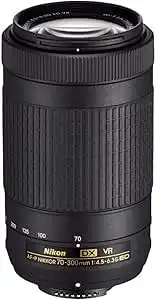
The Nikon AF-P DX NIKKOR 70-300mm f/4.5-6.3G ED VR lens emerges as a compelling option for photographers using Nikon's DX-format DSLR cameras who are seeking to extend their reach without breaking the bank or their back. Positioned as a versatile super-telephoto zoom, this lens is designed to bring distant subjects into sharp focus, making it a valuable tool for a range of photographic genres from wildlife to travel. Its blend of a broad focal range, compact design, advanced autofocus, and effective image stabilization makes it a significant contender in the entry-to-mid level telephoto market.
At its core, the lens offers a focal length range of 70-300mm. When mounted on a DX-format camera, this translates to an effective full-frame equivalent field of view of approximately 105-450mm. This impressive telephoto reach is the lens's primary draw, allowing photographers to capture subjects that are physically far away, filling the frame with details that would otherwise be lost. Whether observing wildlife from a respectful distance, isolating an athlete on a vast playing field, or compressing perspective in a landscape, the 70-300mm range proves highly adaptable.
One of the most notable features of this lens is its remarkably lightweight construction. Tipping the scales at just 415 grams, it is exceptionally portable, a significant advantage for photographers who spend long hours shooting handheld or trekking with their gear. This lightness makes it an ideal companion for travel, where minimizing bulk and weight is often paramount, and for general action photography where quick adjustments and sustained shooting are common. The filter thread of 58mm is also a widely available and affordable size, making it easy to equip the lens with various filters for creative effects or protection.
Optically, the AF-P DX NIKKOR 70-300mm f/4.5-6.3G ED VR utilizes a design featuring 14 elements in 10 groups, including one Extra-Low Dispersion (ED) glass element. The inclusion of ED glass is critical for mitigating chromatic aberrations, which often manifest as colored fringes around high-contrast edges, thereby contributing to sharper images with improved color fidelity. While the maximum aperture of f/4.5 at 70mm narrows to f/6.3 at 300mm, this variable aperture design is a common compromise in lightweight, affordable telephoto zooms, allowing for the lens's compact size and competitive price point. The 7-blade diaphragm contributes to a reasonably smooth out-of-focus background, though the relatively slow maximum aperture at the telephoto end means achieving extremely shallow depth of field will require careful subject isolation and favorable lighting conditions.
Autofocus performance is a significant highlight, thanks to the integration of Nikon's AF-P Stepping Motor. This motor technology delivers autofocus that is not only fast and precise but also exceptionally quiet and smooth. The rapid response of the AF-P system is invaluable for tracking unpredictable or fast-moving subjects, which is why the lens excels in sports and action photography. Furthermore, its near-silent operation makes it particularly well-suited for video recording, eliminating the distracting whirring noises often associated with older autofocus systems. It is important for potential buyers to note, however, that AF-P lenses require compatibility with newer Nikon DSLR bodies, and older models may not support full AF-P functionality. Checking camera compatibility is a crucial step before purchase.
Complementing the robust autofocus is Nikon's proven Vibration Reduction (VR) technology. At the longer end of its focal range, even minor camera shake can lead to noticeable blur. The built-in VR system actively counteracts these vibrations, allowing photographers to shoot handheld at slower shutter speeds than would otherwise be possible, thereby enhancing sharpness and clarity, especially in challenging lighting conditions or when maintaining a faster shutter speed isn't an option. This is a considerable asset for wildlife and sports photographers who often find themselves in dynamic shooting environments.
The lens's versatility makes it suitable for several key photographic pursuits:
- Wildlife Photography: The expansive telephoto reach, combined with quiet AF-P and effective VR, makes it an excellent starter lens for capturing distant animals without disturbing them.
- Sports and Action Photography: Its ability to quickly acquire and track subjects, coupled with the extended focal length, is ideal for freezing fast-paced sporting events or other action.
- Travel Photography: Its lightweight and compact nature, along with its ability to cover a wide range of distant subjects, makes it an indispensable lens for travelers seeking versatility without burden.
- Portraits: While not a fast prime, the 300mm end can be used to create pleasing background compression and separation for outdoor portraits, offering a different aesthetic from shorter lenses. The minimum focus distance of 1.1 meters also allows for capturing tighter shots of subjects.
In conclusion, the Nikon AF-P DX NIKKOR 70-300mm f/4.5-6.3G ED VR is a well-rounded and highly capable super-telephoto zoom lens for Nikon DX-format DSLRs. It offers an impressive combination of extended reach, portability, advanced autofocus, and image stabilization in an accessible package. While its variable maximum aperture might pose limitations in very low light or when aiming for extreme background blur, these are common trade-offs for its class. For photographers seeking an affordable, lightweight, and versatile lens to tackle distant subjects, action, and travel, this AF-P DX NIKKOR lens presents a compelling and highly recommended solution, providing significant value for its capabilities.