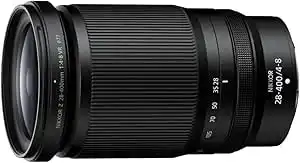
The NIKKOR Z 28-400mm f/4-8 VR lens for Nikon's Z-mount system emerges as a compelling proposition for photographers seeking an unparalleled breadth of focal length in a single optic. Designed specifically for full-frame (FX-format) mirrorless cameras, this superzoom lens positions itself as an incredibly versatile solution, catering to an expansive range of photographic genres without the need for frequent lens changes. Its core appeal lies in its ability to span from a wide-angle 28mm to a super-telephoto 400mm, all while maintaining a relatively manageable physical footprint for its capabilities.
At the heart of the NIKKOR Z 28-400mm's utility is its remarkable 14.2x zoom ratio. This extensive range makes it an outstanding "all-in-one" option, particularly for travel photography, where minimizing gear weight and complexity is paramount. A photographer can effortlessly transition from capturing sweeping landscapes at 28mm to isolating distant architectural details or candid street scenes without swapping lenses. This versatility extends to general purpose shooting, making it an excellent companion for daily outings or family events, where subjects can range from close-up portraits to distant action.
The telephoto end, reaching a substantial 400mm, unlocks opportunities for more specialized photography. For wildlife enthusiasts, 400mm provides significant reach for capturing timid subjects from a distance, while its suitability for sports photography allows users to frame action both wide and tight from the sidelines. The inclusion of Vibration Reduction (VR), offering up to 5.0 stops of compensation, is a critical feature across this entire focal spectrum, especially crucial when shooting handheld at 400mm where even minor camera shake can result in blur. This stabilization system significantly enhances usability in diverse lighting conditions and scenarios where a tripod isn't feasible, contributing to sharper images and more reliable video capture.
Optically, the lens incorporates 21 elements in 15 groups, including ED (Extra-low Dispersion) glass and Aspherical elements. These specialized components are crucial in a superzoom design, working to suppress chromatic aberrations, coma, and distortion across the expansive focal range. While superzoom lenses inherently involve compromises compared to prime lenses or professional-grade f/2.8 zooms, the NIKKOR Z 28-400mm aims to deliver a balanced performance suitable for its target audience. Images are generally sharp at moderate apertures and focal lengths, although, like most lenses of this type, some fall-off in edge sharpness or increased optical aberrations might be observed at the extreme ends of the zoom or wide open.
Autofocus performance is handled by a Stepping Motor (STM) system. This technology is renowned for its speed, precision, and — critically for video shooters — its near-silent operation. The internal focusing (IF) mechanism ensures that the lens's physical length does not change during focusing, maintaining balance and preventing the front element from rotating, which is beneficial for using polarizing filters. Furthermore, the lens boasts a minimum focus distance of just 0.2 meters (at 28mm), allowing for a maximum magnification of 0.35x. This enables surprisingly capable close-up photography, adding another layer of versatility for capturing intricate details of flowers or small objects.
Constructed to withstand the rigors of outdoor photography, the NIKKOR Z 28-400mm features robust weather sealing, protecting it against dust and moisture—a vital attribute for travel and landscape photographers who often find themselves in challenging environments. A fluorine coating on the front element repels dirt, water, and smudges, making cleaning easier and contributing to overall lens durability. Despite its immense focal range, the lens maintains a relatively compact and lightweight profile, weighing in at 725 grams. This makes it highly portable and comfortable for extended handheld shooting sessions. The presence of a programmable control ring offers customizable access to settings like aperture, ISO, or exposure compensation, enhancing the tactile user experience and streamlining workflow.
However, a balanced assessment acknowledges certain trade-offs inherent in a lens of this design. The variable maximum aperture of f/4-8 means that at the telephoto end (e.g., 400mm), the maximum aperture shrinks to f/8. This can limit its performance in low-light conditions, requiring higher ISO settings or slower shutter speeds, even with the effective VR system. It also means achieving a shallow depth of field for subject isolation, particularly at the telephoto end, will be more challenging compared to faster, dedicated telephoto lenses. The 9-blade diaphragm does contribute to reasonably smooth bokeh, but the f/8 maximum aperture at 400mm will inherently limit the degree of background blur achievable.
In conclusion, the NIKKOR Z 28-400mm f/4-8 VR lens is a testament to engineering that prioritizes versatility and convenience. It excels as a single-lens solution for photographers who value flexibility and portability above all else. Its broad focal range, effective VR, fast autofocus, and weather-sealed construction make it an ideal choice for travel, general purpose, landscape, wildlife, sports, and event photography, where adaptability is key. While it naturally involves compromises in maximum aperture and absolute optical perfection compared to more specialized optics, its overall balanced performance and comprehensive feature set make it a highly practical and compelling option for Nikon Z full-frame users looking to minimize their kit without sacrificing photographic potential.