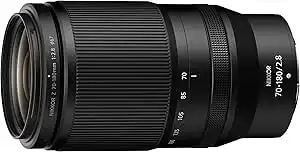
The Nikon NIKKOR Z 70-180mm f/2.8 stands as a compelling and versatile telephoto zoom lens within the burgeoning Nikon Z mirrorless ecosystem. Positioned as a lighter, more compact alternative to the professional-grade NIKKOR Z 70-200mm f/2.8 VR S, this lens offers a constant f/2.8 maximum aperture throughout its zoom range, delivering impressive performance for both enthusiast and professional applications. Its design philosophy emphasizes a balance of optical quality, portability, and value, making it a noteworthy consideration for Z-series camera users.
From a design and build perspective, the NIKKOR Z 70-180mm f/2.8 exhibits a functional and robust construction. Weighing in at approximately 795 grams, it is noticeably lighter than many f/2.8 telephoto zooms, contributing to a more comfortable shooting experience during extended sessions or when traveling. The lens features a weather-sealed design, offering a degree of protection against dust and moisture, which is crucial for outdoor photography in challenging conditions. The internal focusing mechanism ensures that the overall length of the lens remains constant during focus adjustments, aiding in balance and usability with gimbals or other accessories. A 67mm filter thread is a practical choice, allowing for the use of common-sized filters without needing larger, more expensive options often associated with pro-grade telephoto lenses.
Optically, the lens incorporates 19 elements arranged in 15 groups, and its nine-blade diaphragm contributes to rendering pleasingly smooth bokeh. The constant f/2.8 aperture is a significant asset, providing ample light-gathering capabilities for low-light scenarios and enabling precise control over depth of field to isolate subjects effectively. While it is not an S-line lens, which typically signifies Nikon’s absolute pinnacle of optical design, early indications and design principles suggest it aims to deliver very good to excellent sharpness across the frame, especially when stopped down slightly. Aberrations such as chromatic aberration, distortion, and vignetting are generally well-controlled in modern Z lenses, often benefiting from in-camera corrections applied by the Z-series bodies.
Autofocus performance is driven by a Stepping Motor (STM), known for its quiet and smooth operation. This makes the NIKKOR Z 70-180mm f/2.8 well-suited for both still photography and video recording, where silent focusing is paramount. The STM system typically provides fast and accurate autofocus, capable of tracking moving subjects with reasonable proficiency. It's an internal focusing system, further enhancing its operational stealth. A notable feature is its impressive minimum focus distance of just 0.27 meters (0.89 feet) at 70mm, allowing for a maximum magnification ratio of 0.48x. This near-half-macro capability significantly expands the lens's versatility, enabling users to capture intricate close-up details.
The NIKKOR Z 70-180mm f/2.8 truly excels across a variety of use cases, making it a highly adaptable tool:
- Portrait Photography: The 70-180mm focal range offers excellent telephoto compression, flattering perspectives, and the constant f/2.8 aperture, combined with the nine-blade diaphragm, produces beautiful subject isolation and creamy background blur, ideal for professional portraits.
- Event Photography: Its f/2.8 aperture is invaluable for indoor events, weddings, or concerts where ambient light is often limited. The versatile zoom range allows photographers to capture a wide array of shots, from wider environmental context to tight headshots, without constantly changing lenses.
- Sports and Wildlife Photography: While 180mm might not be the longest reach for serious wildlife photography, it's highly competent for closer subjects or larger wildlife, and excellent for many sports. The fast f/2.8 aperture enables faster shutter speeds to freeze action, and the quick autofocus system assists in tracking dynamic subjects. For those requiring more reach, pairing it with Nikon's Z Teleconverter TC-1.4x or TC-2.0x would extend its capabilities, transforming it into a 98-252mm f/4 or a 140-360mm f/5.6 lens respectively, albeit with a stop or two of light loss.
- Low-Light Photography: The constant f/2.8 aperture is a cornerstone for low-light performance, allowing for lower ISO settings or faster shutter speeds than slower variable-aperture zooms, crucial for maintaining image quality in challenging lighting conditions.
- General Telephoto & Travel: Its relatively compact size and lighter weight make it a more appealing option for travel compared to bulkier alternatives. It serves as an excellent general-purpose telephoto zoom for capturing distant landscapes, architectural details, or compelling compositions that benefit from telephoto compression.
It is important to note that unlike its S-line counterpart, the NIKKOR Z 70-180mm f/2.8 does not feature built-in optical image stabilization (VR). Instead, it relies on the in-body image stabilization (IBIS) found in most Nikon Z full-frame cameras. While IBIS is highly effective, dedicated lens VR can sometimes offer superior stabilization at longer focal lengths. However, for many users, the benefits of reduced weight, size, and potentially a more accessible price point will outweigh this difference.
In conclusion, the Nikon NIKKOR Z 70-180mm f/2.8 is a highly capable and well-rounded telephoto zoom lens that effectively carves out its own niche within the Z-mount lineup. It skillfully balances optical performance with practical considerations of size, weight, and cost. Its constant f/2.8 aperture, robust build, reliable autofocus, and impressive close-focusing capabilities make it a strong performer across diverse photographic genres. For Z-series photographers seeking a versatile telephoto zoom that offers excellent low-light performance and beautiful depth of field control without the heft or premium price of Nikon's flagship 70-200mm, this lens presents an extremely compelling proposition.