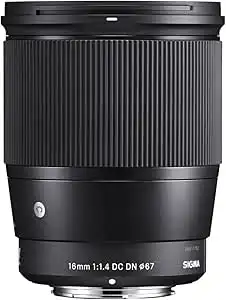
The Sigma 16mm f/1.4 DC DN Contemporary lens stands as a compelling option for APS-C mirrorless camera users, particularly within the E-mount ecosystem. As part of Sigma's "Contemporary Line," it aims to strike an impressive balance between optical performance, compact design, and robust build quality. Its standout feature is undoubtedly the extremely bright f/1.4 maximum aperture combined with a wide 16mm focal length (equivalent to 24mm on a full-frame sensor), positioning it as a go-to choice for photographers seeking versatility in challenging lighting conditions and expansive views.
Build Quality and Ergonomics Weighing in at 405g, the Sigma 16mm f/1.4 DC DN Contemporary feels substantial yet well-balanced on most APS-C mirrorless bodies. The construction is robust, featuring a durable brass bayonet mount that ensures a precise and secure fit. Sigma has also incorporated a weather-sealed mount, offering a degree of protection against dust and splashes, which is a welcome feature for outdoor photographers. The lens barrel is predominantly made of high-quality Thermally Stable Composite (TSC) material, contributing to its manageable weight without compromising on a premium feel. The manual focus ring is smooth and well-damped, providing a satisfying tactile experience for precise adjustments. With a 67mm filter thread, it accommodates a common filter size, simplifying filter acquisition for landscape and long-exposure enthusiasts.
Optical Performance Optically, the Sigma 16mm f/1.4 is engineered for excellence. Its complex optical formula comprises 16 elements in 13 groups, including three FLD (F Low Dispersion) glass elements and two aspherical glass elements. These specialized elements work in concert to significantly minimize optical aberrations across the frame. At its widest aperture of f/1.4, the lens delivers impressive sharpness, particularly in the center of the frame. As one stops down, sharpness extends consistently across the frame, reaching peak performance around f/2.8 to f/4.
Chromatic aberration is generally well-controlled, especially lateral CAs which are often present in wide-angle lenses. Longitudinal CAs (bokeh fringing) are also managed effectively, minimizing color artifacts in out-of-focus areas. Distortion, a common characteristic of wide-angle optics, is present, exhibiting a minor barrel effect, but it is typically manageable with in-camera corrections or post-processing profiles.
For astrophotography, the lens's ability to minimize coma aberration at f/1.4 is particularly noteworthy, rendering stars as distinct pinpoints rather than smeared light sources – a critical aspect for this genre. Vignetting is noticeable at f/1.4 but quickly diminishes as the aperture is stopped down, becoming largely negligible by f/2.8. The 9-blade rounded diaphragm contributes to a pleasing bokeh quality, rendering smooth out-of-focus backgrounds for a wide-angle lens, which can be advantageous when isolating subjects or creating environmental portraits.
Autofocus Performance The autofocus system utilizes a stepping motor, designed to provide quiet, smooth, and fast focusing. In practical use, the AF is generally reliable and responsive for both stills and video applications. The silent operation is particularly beneficial for videographers, preventing distracting motor noise from being picked up by onboard microphones. While not the absolute fastest in the mirrorless market, its accuracy is commendable, locking onto subjects with confidence even in moderately low light. The minimum focus distance of 0.25m allows for some creative close-up shots, though the maximum magnification of 1:9.9 indicates it is not a dedicated macro lens. It is important to note the absence of optical image stabilization (OSS) within the lens itself, meaning users will rely on their camera's in-body image stabilization (IBIS) if available, or a steady hand/tripod for slower shutter speeds in low light.
Use Cases Where This Product Excels This lens truly shines across several photographic disciplines:
- Landscape Photography: The 16mm focal length offers an expansive field of view, ideal for capturing grand vistas and sweeping landscapes. The excellent edge-to-edge sharpness when stopped down ensures fine details are rendered throughout the frame, while the weather-sealed mount provides peace of mind in challenging outdoor conditions.
- Astrophotography: This is arguably where the Sigma 16mm f/1.4 truly excels. Its ultra-wide f/1.4 aperture allows for significantly more light gathering, enabling lower ISOs or faster shutter speeds when photographing the night sky. The effective correction of coma aberration ensures sharp, undistorted stars, making it a favorite for capturing constellations, the Milky Way, and star trails.
- Architecture Photography: The wide perspective is perfect for capturing large structures and interior spaces, while the lens's relatively low distortion (for its class) and good corner sharpness simplify post-processing for architectural lines.
- Street Photography: Despite its f/1.4 aperture, the lens maintains a manageable size and weight, making it a viable companion for street photographers. The wide angle encourages environmental portraits and dynamic compositions, while the fast aperture can be used for subject isolation or working in dimly lit urban environments.
- Low-light Photography: Beyond astrophotography, the f/1.4 maximum aperture is a game-changer for any low-light scenario, from dimly lit interiors to concert venues. It allows for faster shutter speeds to freeze motion or lower ISOs to minimize noise, producing cleaner images than slower lenses.
Conclusion The Sigma 16mm f/1.4 DC DN Contemporary for E-mount is a highly capable and versatile prime lens that offers exceptional value. It consistently delivers on its promise of outstanding optical performance, especially at its wide-open aperture, making it a powerful tool for a diverse range of photographic endeavors. While the absence of optical image stabilization might be a consideration for some, its other strengths—superb sharpness, excellent coma control, robust build, and reliable autofocus—more than compensate. For APS-C mirrorless users seeking a wide, fast, and optically brilliant lens for landscapes, astrophotography, architectural interiors, street scenes, or simply shooting in challenging low-light conditions, this Sigma offering represents an intelligent and highly recommended investment. It's a lens that empowers photographers to capture more light, more detail, and more of the world around them with remarkable clarity.