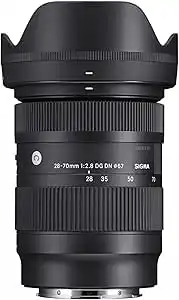
The Sigma 28-70mm f/2.8 EX DG Aspherical lens stands as a testament to third-party manufacturers' commitment to providing high-quality, professional-grade optics for DSLR systems. Designed for full-frame F-mount cameras, this standard zoom lens offers a constant maximum aperture of f/2.8 throughout its focal range, making it a compelling option for a wide array of photographic disciplines.
Build Quality and Ergonomics
Bearing the "EX" (Excellent/Professional) designation, the Sigma 28-70mm f/2.8 reflects a commitment to robust construction. The lens features a solid, high-quality plastic or metal barrel, typical of Sigma's professional series lenses from its era. At a weight of just 510g, it is remarkably light for a full-frame f/2.8 standard zoom, a characteristic that enhances its appeal for extended use or travel. The relatively compact dimensions, especially when compared to some contemporary f/2.8 zooms, contribute to a balanced feel on most DSLR bodies.
The lens utilizes an internal focusing mechanism, a design choice that offers several practical advantages. Internal focusing ensures that the front element does not rotate during focusing, which is crucial for consistent use of polarizing filters or graduated neutral density filters. Furthermore, it generally contributes to faster and quieter autofocus operation, and prevents the lens from extending or retracting, maintaining its physical balance. The 67mm filter thread is a common size, allowing photographers to share filters with other lenses in their kit, potentially reducing overall equipment bulk and cost. The zoom and focus rings are typically smooth and well-damped, providing precise control, which is essential for both still photography and videography.
Optical Performance
The heart of the Sigma 28-70mm f/2.8 EX DG Aspherical lies in its optical design. Comprising 14 elements in 10 groups, including aspherical elements, the lens aims to correct various optical aberrations, such as spherical aberration and distortion, across its zoom range. The "DG" designation confirms its suitability for full-frame digital sensors, ensuring optimal light transmission and minimizing vignetting compared to older, film-era designs.
The constant f/2.8 maximum aperture is arguably the lens's most significant feature. This wide aperture provides excellent light-gathering capabilities, making the lens highly effective in challenging low-light conditions. It also allows for a shallow depth of field, enabling photographers to isolate subjects from their backgrounds with pleasing bokeh. The lens incorporates a 9-bladed diaphragm, which generally contributes to smooth, circular out-of-focus highlights, enhancing the aesthetic appeal of portraits and other selective focus shots.
In terms of sharpness, the lens typically performs very well in the center of the frame, especially when stopped down slightly from its maximum aperture. Wide open at f/2.8, sharpness remains good in the center, though some softening towards the edges and corners may be present, particularly at the wider end of the focal range. Stopping down to f/4 or f/5.6 often yields optimal sharpness across the frame. Vignetting is noticeable at f/2.8, especially at 28mm, but it diminishes quickly when stopped down and can often be corrected in post-processing. Chromatic aberration, while generally well-controlled by the aspherical elements, may still appear in high-contrast situations, though it is usually manageable. Distortion, particularly barrel distortion at 28mm and pincushion distortion at 70mm, is present but within expected limits for a zoom lens of this design and era.
Autofocus Performance
While not equipped with Sigma's more modern Hyper Sonic Motor (HSM), the internal focusing mechanism of the 28-70mm f/2.8 EX DG Aspherical generally provides reliable autofocus. Its speed is typically adequate for most scenarios, including event and portrait photography. For fast-moving action or sports, while capable, it may not match the blistering speed of the latest professional-grade lenses, but for its intended applications, it generally proves responsive and accurate. Compatibility with various F-mount DSLR bodies ensures broad usability.
Use Cases
The versatility offered by the 28-70mm f/2.8 focal range, combined with its constant wide aperture, makes this lens an excellent choice for several specific photographic applications:
- General Purpose Photography: From expansive landscapes at 28mm to tighter compositions at 70mm, this lens covers the most frequently used focal lengths, making it an ideal walk-around lens for everyday shooting.
- Portrait Photography: The f/2.8 aperture, coupled with the 70mm focal length, is superb for creating portraits with beautiful background blur, helping to separate the subject effectively. The 9-bladed diaphragm ensures pleasing out-of-focus areas.
- Event Photography: Whether it's a wedding, a corporate event, or a party, the constant f/2.8 aperture is invaluable for shooting indoors or in variable lighting conditions, allowing for faster shutter speeds and lower ISO settings. Its relatively lightweight design also aids in reducing fatigue during long events.
- Low-Light Photography: As highlighted, the f/2.8 aperture is a significant asset in challenging lighting environments, providing ample light for the sensor and enabling photographers to capture images where slower lenses would struggle.
- Travel Photography: Its compact size and light weight, combined with its versatile zoom range, make it a strong candidate for a single-lens solution when traveling, minimizing the need to carry multiple prime lenses.
Limitations and Considerations
One notable absence in this lens is image stabilization (OS). While an f/2.8 aperture significantly helps in low light, the lack of stabilization means that users must rely on higher ISO settings or faster shutter speeds to prevent camera shake, especially when shooting handheld. For situations demanding very slow shutter speeds, a tripod becomes essential. This is a common trade-off for older f/2.8 standard zooms, where adding optical stabilization would significantly increase size, weight, and cost.
Conclusion
The Sigma 28-70mm f/2.8 EX DG Aspherical is a robust and highly capable standard zoom lens for full-frame F-mount DSLR users. Its constant f/2.8 aperture delivers excellent performance in low light and provides creative control over depth of field, making it well-suited for professional applications such as event and portrait photography, as well as being a versatile general-purpose and travel companion. While it lacks image stabilization and may exhibit some optical imperfections typical of its generation, its strong build quality, relatively light weight, and reliable performance make it a compelling and cost-effective workhorse lens for photographers seeking a fast, versatile zoom for their DSLR system. It remains a valuable tool for those who prioritize a constant f/2.8 aperture in a compact, durable package.