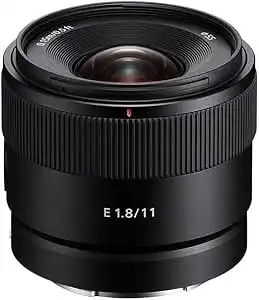
The Sony E 11mm f/1.8 is an ultra-wide prime lens meticulously crafted for Sony's E-mount APS-C mirrorless camera systems. Introduced as a compact yet high-performance option, this lens positions itself as a versatile tool for creators seeking a unique perspective coupled with excellent low-light capabilities. Its combination of an extremely wide field of view, a bright maximum aperture, and a remarkably lightweight design makes it a compelling choice for a diverse range of photographic and videographic applications.
Optical Design and Performance
At its core, the E 11mm f/1.8 boasts a sophisticated optical construction comprising 12 elements arranged in 11 groups. While specific exotic glass types are not detailed, modern Sony lens designs typically incorporate aspherical and Extra-low Dispersion (ED) elements to effectively control various aberrations such as spherical aberration, chromatic aberration, and distortion. This intricate design aims to deliver sharp, clear images across the frame, even at its widest aperture.
The f/1.8 maximum aperture is a standout feature for an ultra-wide lens, allowing for significant light gathering, which is crucial for low-light scenarios. This bright aperture also provides the capability to achieve a surprisingly shallow depth of field, even at a wide focal length, enabling subjects to be isolated from their background with pleasing results. The lens incorporates a 7-blade circular diaphragm, which contributes to smooth and aesthetically pleasing bokeh, particularly when shooting at wider apertures and closer focusing distances. Speaking of close focus, its minimum focusing distance of just 0.12 meters (approximately 4.7 inches) coupled with a maximum magnification of 0.23x allows for dramatic wide-angle close-ups, creating a sense of immersion and unique perspective that can draw viewers into the scene.
Sharpness is expected to be strong in the center, particularly when stopped down slightly, with corners likely showing improvement as the aperture is closed. While ultra-wide lenses often exhibit some degree of barrel distortion, in-camera corrections available on modern Sony bodies, along with post-processing software, can effectively mitigate this for straight lines in architectural or landscape shots. Vignetting, also common in wide-angle lenses at their maximum aperture, is generally correctable without significant impact on image quality.
Autofocus and Handling
Equipped with autofocus, the E 11mm f/1.8 promises quick, precise, and quiet performance, critical for both still photography and video recording. The inclusion of an internal focusing mechanism means that the overall length of the lens does not change during focusing, which maintains balance – an advantage for handheld shooting, gimbal work, or when using filters. This internal focus also helps to keep the front element stationary, simplifying the use of circular polarizers or graduated neutral density filters.
One of the most appealing aspects of this lens is its incredibly lightweight construction, tipping the scales at just 181 grams (approximately 6.4 ounces). This makes it an ideal companion for smaller, lighter APS-C camera bodies, significantly reducing the overall weight of the camera system and enhancing portability. Its compact form factor contributes to a more discreet shooting experience, particularly valuable for street photography or travel. The 55mm filter thread is a common size, making it easy for users to find and utilize a variety of filters. Furthermore, its dust and moisture-resistant design provides an extra layer of durability, making it suitable for use in challenging outdoor environments, aligning well with its potential for landscape and astrophotography.
Key Use Cases
The Sony E 11mm f/1.8 excels across several specific applications:
-
Vlogging: For content creators, the 11mm focal length on an APS-C sensor provides an ideal ultra-wide view that comfortably captures the vlogger at arm's length while still including ample background context. The bright f/1.8 aperture is excellent for low-light environments, such as indoor vlogging or evening walks, and allows for subject separation from the background. Its minimal weight is paramount for comfortable handheld shooting over extended periods, reducing arm fatigue. The internal focusing ensures stable footage, preventing shifts in balance during focus adjustments.
-
Landscape Photography: The ultra-wide field of view is a natural fit for capturing expansive landscapes, dramatic vistas, and grand sweeping scenes. It allows photographers to encompass vast amounts of detail, emphasizing scale and depth. The f/1.8 aperture, while often stopped down for maximum depth of field in landscapes, offers flexibility for creative effects or shooting in dimmer conditions. The dust and moisture resistance is a clear advantage for outdoor landscape work.
-
Architecture Photography: This lens is well-suited for architectural photography, both interiors and exteriors. Its wide perspective enables photographers to capture entire structures or expansive interior spaces, highlighting their design and scale. The ability to correct distortion in post-processing ensures that straight lines remain true.
-
Street Photography: Its compact size and light weight make it unobtrusive for street photographers who prefer to blend in. The wide perspective offers an immersive view, capturing subjects within their environmental context, telling a broader story of urban life. The f/1.8 aperture provides excellent low-light performance for available light shooting in diverse conditions.
-
Astrophotography: Perhaps one of the most compelling use cases, the f/1.8 maximum aperture is a significant asset for astrophotography. When combined with the ultra-wide 11mm focal length, it becomes an excellent choice for capturing the Milky Way, star trails (with appropriate techniques), or aurora borealis on APS-C sensors. The bright aperture gathers substantial light, allowing for lower ISO settings and shorter exposure times to minimize star trailing, resulting in cleaner, more detailed night sky images.
Considerations
While exceptionally versatile, it's important to acknowledge a few considerations. As a prime lens, it has a fixed focal length, meaning photographers must "zoom with their feet" to adjust their composition, which may not suit every shooting style. Additionally, the lens does not feature optical image stabilization. While many modern Sony APS-C cameras incorporate In-Body Image Stabilization (IBIS), users with older bodies lacking this feature will need to rely on faster shutter speeds or external stabilization for handheld video or low-light photography to avoid blur.
Conclusion
The Sony E 11mm f/1.8 stands out as a high-quality, ultra-wide prime lens for Sony APS-C E-mount cameras. Its unique blend of an extremely wide field of view, a bright f/1.8 aperture, exceptional portability, and robust construction makes it a highly attractive option. It particularly excels in catering to vloggers, landscape and architecture enthusiasts, street photographers, and astrophotographers who demand a compact lens capable of delivering stunning results in challenging conditions. For those seeking to add an immersive, high-performance ultra-wide perspective to their APS-C kit, this lens represents a valuable and versatile addition.