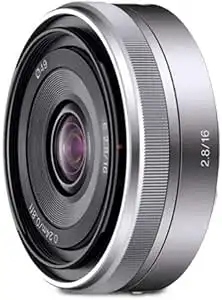
Review: Sony E 16mm f/2.8 Pancake Lens
The Sony E 16mm f/2.8 Pancake lens, bearing the model designation SEL16F28, stands as a testament to engineering priorities centered on portability and discretion. Designed exclusively for Sony's APS-C E-mount mirrorless cameras, this prime lens offers a wide-angle perspective in an exceptionally compact and lightweight package. Its "pancake" form factor is its defining characteristic, making it an appealing option for photographers seeking to minimize their gear's footprint without entirely sacrificing optical capabilities.
Design and Build Quality
Weighing a mere 67 grams and measuring a scant 22.5mm in length, the E 16mm f/2.8 is astonishingly small, effectively turning even larger APS-C camera bodies into more manageable and less conspicuous setups. The lens's construction is primarily plastic, a sensible choice given its extreme weight reduction goals, yet it feels reasonably robust for its class. The 49mm filter thread is a common size, allowing for easy integration with existing filter sets. The lens features an internal focusing mechanism, which means the front element does not extend during focus, a benefit for balance, handling, and the use of polarizing or graduated neutral density filters. The focus ring operates smoothly, offering a comfortable tactile experience for manual adjustments, although most users will likely rely on its autofocus capabilities.
Optical Performance
Optically, the Sony E 16mm f/2.8 presents a balanced performance, with certain characteristics typical of ultra-compact wide-angle lenses. Comprising 5 elements in 5 groups, its optical formula is relatively simple, contributing to its small size and weight. The 16mm focal length on an APS-C sensor provides an angle of view equivalent to approximately 24mm on a full-frame camera. This classic wide-angle perspective is highly versatile, lending itself well to capturing broad scenes, fitting subjects into environmental contexts, and creating a sense of immersion.
At its maximum aperture of f/2.8, the lens delivers adequate central sharpness, which is commendable for a lens of this design and price point. However, consistent with many wide-angle pancake lenses, corner sharpness tends to diminish, particularly at wider apertures. Stopping down to f/5.6 or f/8 significantly improves edge-to-edge sharpness, making it a more reliable performer for landscape or architectural photography where consistent detail across the frame is paramount.
Chromatic aberration, often manifested as purple or green fringing in high-contrast areas, is present but generally well-controlled and correctable in post-processing. Vignetting (darkening of the image corners) is noticeable at f/2.8 but quickly dissipates as the aperture is stopped down. Barrel distortion is also a characteristic of this wide-angle prime, but modern Sony cameras can apply in-camera corrections, and most RAW processing software effectively remedies it, rendering it a minor concern for most users. The 7-bladed circular aperture helps produce a reasonably smooth, if not overtly creamy, bokeh when shooting close to the minimum focus distance of 0.24 meters, allowing for some subject separation despite its wide focal length.
Autofocus Performance
The autofocus system of the E 16mm f/2.8 is generally quick and quiet, making it suitable for both still photography and video recording. The internal focusing design contributes to its stealthy operation, preventing any external movement or noise that might be distracting. In good lighting conditions, focus acquisition is swift and accurate. In lower light, performance remains respectable, though it may exhibit a slight slowdown, a common trait for lenses in this class without advanced focusing motors. Its consistent performance makes it a reliable companion for capturing fleeting moments in street photography or tracking subjects in vlogging scenarios.
Use Cases Where It Excels
The Sony E 16mm f/2.8 truly shines in specific photographic genres where its unique blend of attributes is highly advantageous:
-
Street Photography: Its ultra-compact and lightweight nature makes it incredibly discreet. Paired with a small APS-C body, it forms an unobtrusive setup, allowing photographers to capture candid moments without drawing undue attention. The 24mm-equivalent field of view is ideal for encompassing environmental context with subjects.
-
Travel Photography: For travelers conscious of luggage weight and bulk, this lens is a dream. Its negligible weight means it can be easily carried all day, and its wide-angle perspective is perfect for documenting landscapes, cityscapes, and interior spaces without requiring significant effort.
-
Landscape Photography: While not the sharpest wide-angle lens available, when stopped down to f/8 or f/11, it delivers commendable landscape images. Its wide field of view allows for expansive vistas, and its small size makes it an excellent choice for hiking where every gram counts.
-
Vlogging and Everyday Photography: For content creators, the 16mm focal length is excellent for vlogging, providing enough width for arm's-length shooting while still including some background context. Its internal focusing and quiet operation are beneficial for video. For everyday shooting, its versatile wide-angle view and compact form factor make it an ideal walk-around lens, ensuring you always have a capable lens at hand for capturing life's moments.
Limitations and Considerations
It's important to acknowledge that the E 16mm f/2.8 does not feature optical image stabilization. While many modern Sony APS-C cameras now incorporate in-body image stabilization (IBIS), users with older bodies or those seeking maximum stability in challenging conditions will need to rely on faster shutter speeds or tripods. As noted, wide-open sharpness, particularly at the edges, can be a limitation for pixel-peepers or those requiring critical edge-to-edge detail. The fixed focal length, by its nature, requires the photographer to "zoom with their feet," which can be a creative exercise but also a practical constraint in certain situations.
Conclusion
The Sony E 16mm f/2.8 Pancake lens is not a lens designed to push the boundaries of optical perfection, but rather to excel in portability, versatility, and convenience. It represents an excellent trade-off for photographers prioritizing a minimal, lightweight setup without sacrificing a useful wide-angle perspective. Its strengths lie in its inconspicuous nature, making it a compelling choice for street, travel, and everyday photography, as well as for vlogging. While it has optical quirks typical of its design, these are largely manageable and outweighed by the sheer utility and joy of using such a compact, capable lens. For Sony APS-C users seeking a go-anywhere wide-angle prime that won't weigh them down, the E 16mm f/2.8 remains a highly relevant and recommended option.