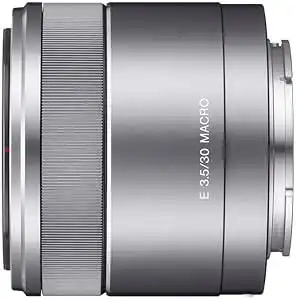
The Sony E 30mm f/3.5 Macro (SEL30M35) stands as a testament to Sony's commitment to providing versatile and specialized optics within its E-mount mirrorless system. Designed specifically for APS-C sensors, this compact and lightweight prime lens carves a niche for itself by offering true 1:1 macro magnification, making it an invaluable tool for photographers seeking to explore the intricate world of close-up photography. Beyond its primary macro capabilities, its "normal" focal length equivalent on APS-C also positions it as a surprisingly capable lens for a variety of general photographic endeavors.
At its core, the SEL30M35 is engineered for detail. With a fixed focal length of 30mm, it translates to an approximate 45mm equivalent field of view on a full-frame camera, providing a perspective that is naturally aligned with human vision. This "standard" focal length is inherently versatile, making it comfortable for everyday use, street photography, or environmental portraits where a natural perspective is desired. The maximum aperture of f/3.5, while not exceptionally fast compared to some primes, is entirely practical, especially given its macro specialization. For close-up work, wider apertures often result in an extremely shallow depth of field, which can be challenging, so f/3.5 offers a good balance of light gathering and manageable depth for macro subjects. The minimum aperture extends to f/22, providing ample depth of field control for landscapes or when maximizing sharpness from front to back is crucial.
The defining characteristic of this lens is its exceptional macro capability. It boasts a true 1:1 (1.0x) magnification ratio, allowing photographers to capture subjects at life-size on the camera's sensor. This level of magnification is crucial for revealing the minute textures, patterns, and structures of small objects, be it insects, flowers, coins, or jewelry. To achieve this, the lens features a remarkably close minimum focus distance of just 0.095 meters (approximately 3.7 inches) from the sensor plane. This close proximity, while enabling stunning close-ups, does mean a relatively short working distance, which can be a consideration when photographing skittish living subjects.
Optically, the SEL30M35 comprises 7 elements arranged in 6 groups, a configuration designed to deliver sharp, clear images. The inclusion of aspherical and Extra-low Dispersion (ED) elements is significant. Aspherical elements help to suppress spherical aberrations, contributing to superior sharpness and contrast, especially at wider apertures, and can reduce the overall number of elements required, thus contributing to the lens's compact design. ED elements, on the other hand, are crucial for minimizing chromatic aberrations, which appear as distracting color fringing, particularly in high-contrast areas. This careful optical design suggests a lens capable of producing images with good detail and accurate color rendition. The 7-bladed circular aperture mechanism further contributes to the aesthetic quality of images, rendering smooth and pleasing out-of-focus areas, commonly known as bokeh, which is particularly evident when shooting at close distances.
Physically, the lens is a marvel of compactness and lightweight design. Weighing in at a mere 138 grams (approximately 4.9 ounces) and featuring a modest 49mm filter thread, it's an ideal companion for smaller APS-C mirrorless bodies. This diminutive size and weight make it incredibly portable, ensuring it can be carried effortlessly throughout the day without adding bulk or fatigue. The internal focusing mechanism is another practical advantage; the lens barrel does not extend during focusing, which maintains a consistent length and balance. This feature is especially beneficial for macro work where precise positioning and avoiding disturbances to the subject are paramount. It also helps to prevent dust ingress and allows for easier use of polarizers or graduated neutral density filters since the front element does not rotate.
The Sony E 30mm f/3.5 Macro truly excels in a handful of specific use cases. Its primary domain is, without question, Macro Photography. For anyone wishing to delve into the intricate beauty of the miniature world, this lens offers an affordable and highly capable entry point. Its 1:1 magnification allows for breathtaking detail capture, making it suitable for scientific documentation, botanical studies, or artistic explorations of textures and patterns. Beyond living subjects, it is exceptionally well-suited for Product Photography and Detail Photography. Small items like jewelry, watches, electronic components, or food can be photographed with immense clarity and precision, revealing every facet and texture. The 30mm focal length, translating to a "normal" perspective, ensures that products are rendered without excessive distortion, making it a reliable choice for e-commerce and commercial applications.
Furthermore, its versatility extends to Everyday Photography. The 45mm full-frame equivalent focal length provides a natural, unobtrusive field of view that is excellent for general shooting. Whether capturing casual street scenes, travel moments, or family events, the lens's compact size and lightweight nature make it a comfortable and discreet option. While the f/3.5 aperture isn't a low-light champion, it's perfectly adequate for well-lit scenarios, and the lens's inherent sharpness often makes up for the lack of extreme speed.
However, a balanced review also acknowledges limitations. The absence of built-in optical image stabilization (OSS) means that users relying on this lens for handheld general photography, especially in lower light, will need to depend on their camera body's in-body image stabilization (IBIS) system, if present. For macro photography, where a tripod is frequently employed, this is less of a concern. The f/3.5 maximum aperture, while suitable for macro, might prove restrictive for photographers seeking to achieve extremely shallow depth of field in non-macro contexts or for consistently shooting in very dim conditions without raising ISO. The relatively short working distance at 1:1 magnification, while a characteristic of many compact macro lenses, can be challenging for some subjects or lighting setups.
In conclusion, the Sony E 30mm f/3.5 Macro is an excellent choice for APS-C E-mount photographers looking for an affordable, lightweight, and compact lens that delivers true 1:1 macro capabilities. Its optical performance, supported by aspherical and ED elements, provides sharp and aberration-controlled images. While its f/3.5 aperture and lack of OSS require some consideration, its strengths in macro, product, and detail photography, combined with its versatility as an everyday prime, make it a valuable and well-rounded addition to any APS-C E-mount kit. It empowers photographers to capture the world's smallest wonders with remarkable fidelity and offers a practical, unobtrusive option for general shooting.