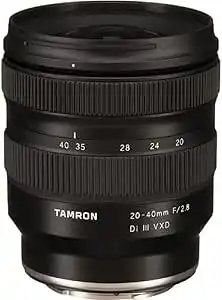
Tamron 20-40mm f/2.8 Di III VXD (Model A062) Review: The Ultra-Compact Wide-Angle Workhorse
The Tamron 20-40mm f/2.8 Di III VXD, model A062, stands out in the crowded Sony E-mount full-frame mirrorless lens ecosystem by offering a unique blend of a versatile wide-angle to standard zoom range, a constant f/2.8 aperture, and an exceptionally compact, lightweight design. Pitched as an ideal companion for a variety of shooting scenarios, from dynamic video capture to everyday street photography, this lens aims to provide professional-grade performance without the bulk often associated with f/2.8 zooms.
From a design and ergonomics perspective, the Tamron 20-40mm f/2.8 immediately impresses with its astonishingly low weight of just 365g. This makes it one of the lightest constant f/2.8 full-frame zoom lenses available, a significant advantage for creators prioritizing portability, particularly those who frequently travel or engage in extended handheld shooting. Its compact form factor also renders it highly suitable for use on gimbals and stabilizers, where balancing bulky lenses can be a challenge. The build quality, while lightweight, incorporates Tamron's well-regarded Moisture-Resistant Construction, offering peace of mind when shooting in less-than-ideal weather conditions. The front element features a Fluorine Coating, which repels moisture and oils, making it easier to clean and maintain. A 67mm filter thread, common across many Tamron Di III lenses, simplifies filter management for users who own multiple lenses from the brand.
Optically, the lens is constructed with 15 elements in 11 groups and features 9 diaphragm blades, promising smooth out-of-focus areas (bokeh) when shooting at wider apertures. The constant f/2.8 maximum aperture is a cornerstone of this lens's appeal, providing excellent low-light performance and the ability to isolate subjects with a pleasing depth of field. While detailed lab tests often provide specific sharpness metrics, Tamron's recent f/2.8 zooms have generally delivered strong optical performance, and the 20-40mm f/2.8 is expected to continue this trend. Sharpness is generally robust across the frame, especially in the central areas, and remains consistent throughout the zoom range. As with many wide-angle zooms, some degree of vignetting and distortion might be present at the extreme wide end, but these are typically well-controlled or easily correctable through in-camera profiles and post-processing software. Chromatic aberrations are also generally well-managed, contributing to clean and crisp image files.
The autofocus system is powered by Tamron's VXD (Voice-coil eXtreme-torque Drive) linear motor mechanism. This advanced AF drive is renowned for its speed, precision, and near-silent operation. For still photographers, this translates to confident and fast acquisition of focus, even in challenging light. For videographers, the quiet operation of the VXD motor is particularly beneficial, preventing unwanted AF noise from being picked up by microphones during recording. Its responsiveness is also crucial for tracking moving subjects, making it a reliable choice for dynamic content creation.
The true strength of the Tamron 20-40mm f/2.8 lies in its versatility and the specific use cases it excels in. Its unique focal range, starting at an ultra-wide 20mm and extending to a comfortable 40mm, coupled with its compact size, makes it an excellent choice for:
- Vlogging and Video: The 20mm wide end is perfect for arm's length vlogging, ensuring both the presenter and surrounding context are captured. Its light weight makes it ideal for handheld video and gimbal use, while the silent VXD AF ensures smooth, unobtrusive focusing during filming. The f/2.8 aperture offers flexibility in varying light conditions.
- Landscapes: The 20mm focal length provides an expansive field of view for grand landscapes, and the f/2.8 aperture allows for good performance in twilight or for capturing starry skies. Its lightweight nature is a significant advantage for landscape photographers who often hike to remote locations.
- Street Photography: The compact size and relatively unassuming appearance make the lens discreet for street shooting. The 20-40mm range covers a broad spectrum from wide environmental shots to slightly tighter, more documentary-style frames, while the f/2.8 aperture allows for creative depth-of-field control and low-light capability.
- Environmental Portraits: The focal range allows photographers to capture subjects within their surroundings, providing context to the portrait. The f/2.8 aperture helps separate the subject from the background without completely blurring the environment.
- Casual Astrophotography: While not an extreme ultra-wide, the 20mm f/2.8 is a very capable focal length and aperture combination for wide-field astrophotography, particularly for capturing starscapes and the Milky Way. Its relatively low weight also makes it a good travel companion for such endeavors.
Beyond its primary applications, the lens offers a remarkably close minimum focusing distance of 0.17m (6.7 inches) at the 20mm end, resulting in a maximum magnification ratio of 1:3.8. This capability allows for compelling close-up shots with interesting perspectives, adding another layer of creative versatility. The compatibility with Tamron's Lens Utility software further enhances its appeal, allowing users to customize focus settings, update firmware, and assign functions to the focus set button, providing a tailored shooting experience.
However, it's important to acknowledge some considerations. The lens lacks built-in optical image stabilization, relying instead on the in-body image stabilization (IBIS) present in most modern Sony full-frame mirrorless cameras. While IBIS is effective, some users might prefer the added stability of lens-based IS, especially at slower shutter speeds or during handheld video. Additionally, while the 20-40mm range is uniquely useful, it doesn't extend into the more common 50mm or 70mm "standard zoom" territory, meaning users might need to carry a second, longer lens if their shooting requires tighter compression or standard portrait focal lengths.
In conclusion, the Tamron 20-40mm f/2.8 Di III VXD (Model A062) carves out a distinct niche in the E-mount lineup. It presents a compelling option for content creators, photographers, and videographers seeking a remarkably compact and lightweight wide-angle to standard zoom with a constant f/2.8 aperture. Its rapid and silent autofocus, robust optical performance, and weather-sealed construction make it a highly capable and reliable tool. For those whose primary needs align with vlogging, travel, street photography, landscapes, or casual astrophotography, this lens offers an appealing balance of performance, portability, and value, proving itself a versatile workhorse for a wide array of demanding creative endeavors.