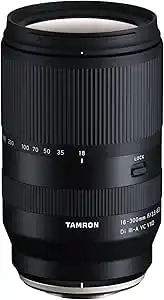
The Tamron 18-300mm f/3.5-6.3 Di II VC PZD stands as a compelling all-in-one zoom lens, explicitly engineered for APS-C DSLR cameras featuring the F-mount. With its remarkable 16.6x zoom ratio, spanning from a wide 18mm to a super-telephoto 300mm, this lens aims to be a single, versatile solution for photographers seeking to minimize gear while maximizing photographic opportunities. Bolstered by Tamron’s Vibration Compensation (VC) and a swift, quiet PZD (Piezo Drive) autofocus motor, it offers a robust package for a diverse range of shooting scenarios.
Unparalleled Versatility: The 18-300mm Zoom Range
The defining characteristic of this Tamron lens is undoubtedly its expansive 18-300mm focal length range. For APS-C sensor cameras, this translates to an effective full-frame equivalent of approximately 27-450mm (Nikon/Sony) or 28.8-480mm (Canon), depending on the specific camera's crop factor. This incredible reach means a photographer can transition from sweeping landscapes at the wide end to distant wildlife or sports action at the telephoto end, all without the need to swap lenses. This convenience is paramount for situations where changing lenses is impractical, risky (due to dust), or simply undesirable, such as during travel, hiking, or family outings.
This broad focal range makes the lens an excellent choice for a variety of photographic genres. For landscapes, the 18mm wide-angle allows for capturing expansive vistas. The telephoto end is invaluable for isolating elements within a scene or for casual wildlife and sports photography, bringing distant subjects closer. For portraits, the longer focal lengths can provide pleasing subject compression, though the variable aperture will influence background blur. Its "all-in-one" nature inherently suits everyday photography and travel, offering a lens that can adapt to almost any situation encountered throughout a day.
Optical Performance & Characteristics
As with any superzoom lens, the Tamron 18-300mm f/3.5-6.3 Di II VC PZD inherently presents a balance between optical performance and the sheer convenience of its zoom range. The variable maximum aperture of f/3.5 at the wide end, shrinking to f/6.3 at the telephoto end, is a common characteristic of such versatile lenses. While f/3.5 is respectable for many outdoor and well-lit indoor scenarios, the f/6.3 at 300mm means that low-light performance will be more challenging, requiring higher ISO settings or slower shutter speeds. Likewise, achieving extreme shallow depth of field for subject isolation can be more difficult compared to faster prime lenses or constant-aperture zooms, especially at the telephoto end where f/6.3 provides less background separation than wider apertures. The minimum aperture ranges from f/22 to f/40, providing extensive depth of field when desired.
The lens construction comprises 16 elements arranged in 13 groups, a complex optical formula necessary to manage aberrations across such a vast focal range. While specific optical test data can vary, superzooms generally offer good sharpness in the mid-range of their focal length, with potential for some softening, especially at the extreme ends (18mm and 300mm) when shot wide open. Users can also expect some degree of distortion (barrel at wide, pincushion at telephoto) and vignetting, particularly at wider apertures, though modern camera bodies often apply in-camera corrections for these. The 7 diaphragm blades contribute to a reasonably pleasing bokeh quality in appropriate conditions, preventing overly harsh out-of-focus elements.
Advanced Technologies for Reliable Shooting
A significant advantage of this Tamron lens is the inclusion of its proprietary technologies. The VC (Vibration Compensation) system is a critical feature, particularly given the extended telephoto reach. It effectively counters camera shake, allowing photographers to shoot handheld at slower shutter speeds than would otherwise be possible, thereby improving sharpness in less-than-ideal lighting conditions or at the longest focal lengths. This is invaluable for genres like casual sports and wildlife, where fast shutter speeds are often needed, but maintaining stability is equally important.
The PZD (Piezo Drive) autofocus motor ensures swift, quiet, and precise focusing. This motor type is known for its smooth operation, which is beneficial not only for still photography – allowing for quick capture of decisive moments – but also for video recording, minimizing distracting AF noise during footage acquisition. The lens's Moisture-Resistant Construction further enhances its utility, offering a degree of protection against light rain or humidity, making it a more reliable companion for outdoor excursions and travel photography where weather conditions can be unpredictable.
Build & Handling
Weighing in at a manageable 540g, the Tamron 18-300mm is relatively lightweight for a lens offering such an expansive zoom range. This makes it comfortable to carry and shoot with for extended periods, reducing fatigue during travel or long shooting sessions. The 62mm filter thread is a common size, allowing for easy adoption of various filters. A minimum focus distance of 0.49 meters and a maximum magnification of 1:3.5 provide decent close-up capabilities, allowing for detailed shots of smaller subjects, though it is not a dedicated macro lens. The "Di II" designation confirms its design specifically for APS-C sensors, ensuring optimal image circle coverage for these cameras.
Balanced Perspective: Understanding the Compromises
While the Tamron 18-300mm f/3.5-6.3 Di II VC PZD excels in convenience and versatility, it’s important to approach it with a balanced understanding of its inherent compromises. As an all-in-one superzoom, it cannot match the specialized optical performance, low-light capabilities, or wide maximum apertures of prime lenses or more specialized, narrower-range zooms. Its variable aperture limits its effectiveness in very dim environments and offers less control over depth of field compared to faster alternatives. However, for photographers who prioritize the ability to capture a vast array of subjects without the encumbrance of multiple lenses, these trade-offs are often well worth it.
Conclusion
The Tamron 18-300mm f/3.5-6.3 Di II VC PZD is a highly practical and versatile lens tailored for APS-C DSLR users. It shines as an ideal companion for travel photography, everyday shooting, and for photographers who wish to explore various genres from landscapes to casual wildlife and portraits with a single, dependable optic. Its combination of an enormous zoom range, effective Vibration Compensation, and a responsive autofocus system, coupled with a moisture-resistant build, makes it a compelling choice for those seeking maximum convenience and flexibility in their photography without sacrificing reasonable image quality for its class. For photographers who embrace the "one lens to rule them all" philosophy, this Tamron lens represents an excellent and balanced solution.